Voxtral TTS sells open control with a license catch
Voxtral TTS gives builders more control over voice agents, but Mistral's CC BY-NC license keeps the self-hosted commercial path behind a gate.

 ainewssilo.com
Voxtral TTS is interesting because builders want the voice layer under their control, not because the market was begging for one more benchmark card.
Mistral launched Voxtral TTS with the sort of positioning that immediately invites the "ElevenLabs challenger" headline. Fair enough. The company says its 4B-parameter model can generate expressive speech in nine languages, adapt to new voices from as little as three seconds of reference audio, and run either through Mistral's API or as open weights on Hugging Face. Stop there and you get a normal launch-week horse race.
The more interesting story is that Voxtral is hot because it promises control over the voice layer at the exact moment voice agents are graduating from demo gimmick to product infrastructure. That is why the Hugging Face release matters. It lets builders inspect the weights, test their own serving path, and imagine a future where the voice stack is not permanently rented from one vendor.
The catch is also sitting right there on Hugging Face, waving politely but firmly. The provided voice references are licensed under CC BY-NC 4.0, and the model card says the model inherits that license. In other words, the part of the launch that feels open and empowering also arrives with a non-commercial-use footnote attached. Product pages never love that sentence. Readers should.
The easy headline is ElevenLabs. The real story is control
Mistral clearly wants the competitive framing. Its launch post says Voxtral TTS beats ElevenLabs Flash v2.5 on naturalness while keeping similar time-to-first-audio, and says it reaches parity with ElevenLabs v3 on quality. The paper gives the sharper number: a 68.4% win rate over ElevenLabs Flash v2.5 in multilingual human evaluations for voice cloning. Those are meaningful claims. They are also Mistral's own claims.
That distinction matters because voice benchmarks are particularly easy to oversell. Human preference tests are useful, but they are not divine law, and a benchmark card is still a benchmark card even when it arrives with a lovely accent. If you need a refresher on how fast scorecards turn into theater, our piece on benchmark trust recession remains annoyingly relevant.
The market signal I care about more is smaller and less glamorous. The Hacker News thread on the launch was modest, not a parade, but one early reaction was someone wondering whether they could move an existing OpenAI voice workload over to Mistral. Tiny thread, useful tell. The appetite here is not mainly for a prettier demo voice. It is for leverage.
That same appetite sits underneath Mistral's broader enterprise pitch in Mistral Forge turns enterprises into model owners. Buyers want more say over how AI behaves, where it runs, and which parts of the stack they truly own. Voxtral TTS brings that instinct into the voice layer.
Open weights, but not open-ended commercial rights
This is where the launch gets genuinely interesting instead of merely loud.
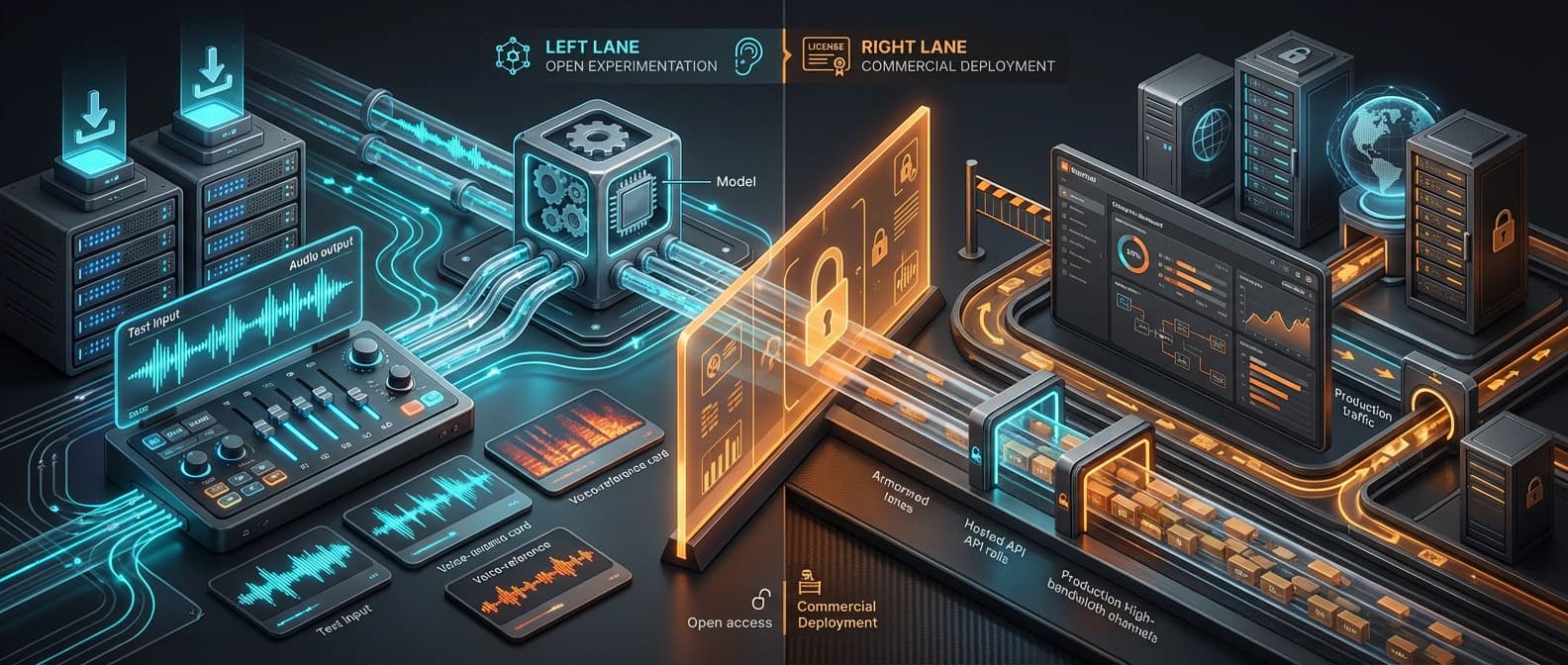
Mistral is offering two lanes at once. The API is live now at $0.016 per 1,000 characters, which is the clean commercial route. The open-weights release is the control route. The problem is that the control route is not a blanket commercial route, because the released model inherits the CC BY-NC licensing of the bundled voice references. That does not make the release fake. It does make it conditional.
So yes, builders can download Voxtral, test it, benchmark it, wire it into experiments, and explore self-hosting options. The Hugging Face card even says the BF16 weights can run on a single GPU with at least 16 GB of memory, with vLLM-Omni recommended for serving. That is a real technical invitation. It is not, by itself, a universal legal green light for commercial deployment.
This is the part of the story many quick recaps will blur, because "open weights" sounds cleaner than "open weights with a material non-commercial footnote." But the footnote is the story. Voxtral is attractive precisely because developers and enterprises want more control over voice generation. If the commercial terms still nudge them back toward Mistral's hosted lane, then the launch is doing something clever: it sells openness as strategy while keeping the safest business path on-platform.
That is not scandalous. It is just not the same thing as full commercial openness. Think of it as a very 2026 compromise: touch the weights, admire the control, then call sales for the grown-up version.
Why the voice layer suddenly matters so much
Voice used to be treated like frosting. Nice to have, slightly uncanny, easy to push off to a specialist vendor. That is changing. As real-time assistants and voice agents move closer to customer support, translation, field operations, and workflow automation, speech stops being decoration and starts becoming part of the control plane.
That is why this launch sits neatly beside Gemini 3.1 Flash Live as Google's real-time agent rail. The industry is not only competing on who can make a synthetic voice sound warmer. It is competing on who owns the live interaction layer for future agents. Latency, voice adaptation, multilingual output, deployment choice, and tool integration all start to matter at the same time.
The open-weight angle matters here because control over voice is operational, not philosophical. Teams may want custom voices, local hosting, tighter privacy handling, or the ability to tune a stack around their own workflow instead of someone else's API roadmap. That logic is the same one we covered in open-weight inference economics: open control only pays off if it changes the operating outcome.
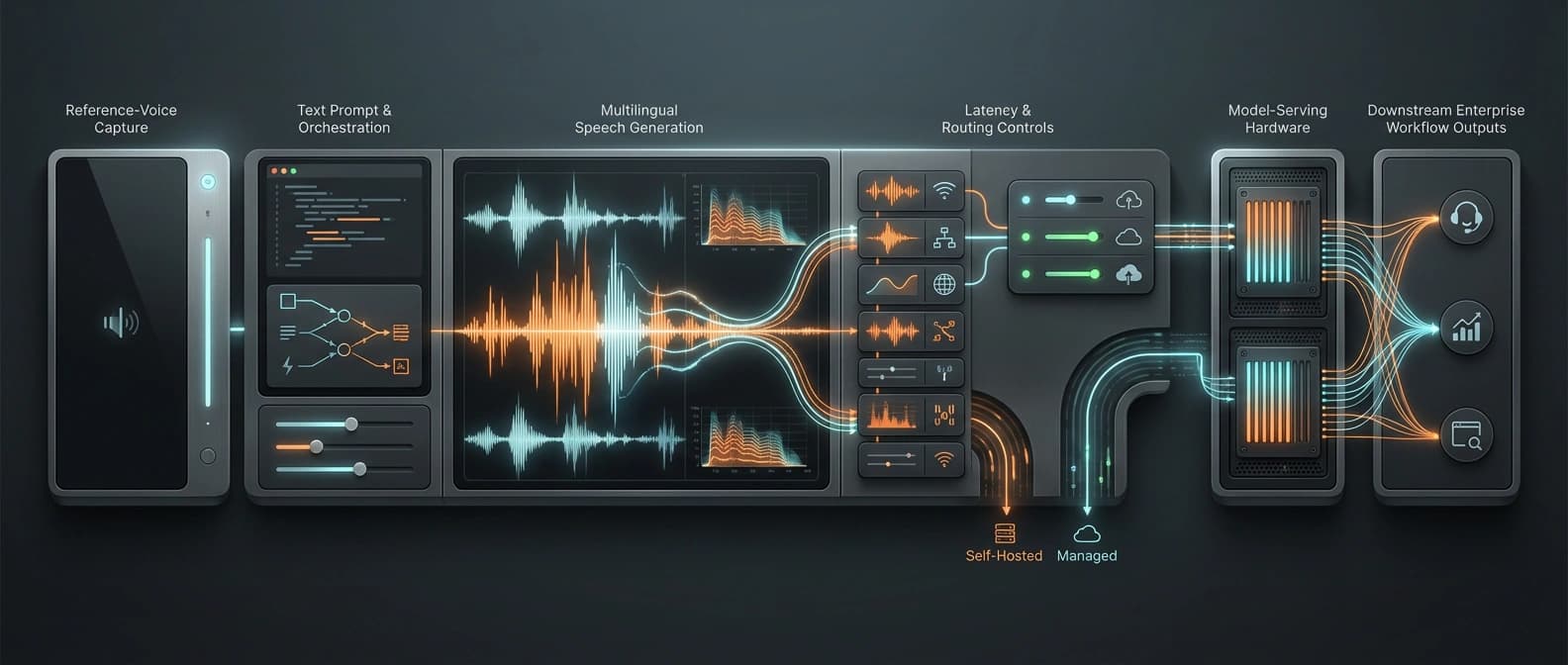
Voxtral gives Mistral a credible way into that conversation. A compact 4B model is large enough to sound serious and small enough to suggest real deployment experimentation. The published latency framing, the short-reference voice adaptation, and the vLLM-Omni path all help the story. So does the fact that Mistral is not pitching Voxtral as a toy narrator for blog posts. The launch copy is explicitly aimed at enterprise voice workflows and voice agents, which is where budgets live and where control arguments stop being aesthetic.
What Voxtral needs before builders bet on it
The next question is not whether Voxtral can win a same-day news cycle. The launch materials were enough to guarantee that. The real question is whether Mistral turns this into a durable control play.
A few things would matter quickly. First, licensing clarity. If the commercial answer for serious deployment is "use the API," then the open-weights lane may remain more strategic teaser than market breaker. Second, ecosystem support. If the vLLM-Omni path becomes boring and reliable, Voxtral gets much more interesting to operators. Boring is underrated; boring is how infrastructure sneaks into production. Third, independent evaluation. Mistral's benchmark claims are enough to justify attention, not enough to close the case.
That leaves Voxtral in a very strong, very modern position. It looks like an open-weights ElevenLabs challenger. It also looks like a reminder that "open" in AI now comes in several commercial flavors, and some of them are more like tasting menus than buffets.
That tension is why the launch matters. People are not excited about Voxtral TTS because they were desperate for another text-to-speech press release. They are excited because the voice layer is becoming strategic, and control is suddenly worth chasing even when the fine print still wants a word.
Source file
Public source trail
These links anchor the package to the underlying reporting trail. They are not a substitute for judgment, but they do show where the reporting starts.
Launch post establishing the 4B parameter size, 9-language support, latency claims, API pricing, and Mistral's direct ElevenLabs comparison framing.
Model card confirming the open-weights release, BF16 serving guidance, supported outputs, and the inherited CC BY-NC 4.0 licensing note.
Paper abstract supplying the 68.4% human-eval win-rate claim over ElevenLabs Flash v2.5 and the 'as little as 3 seconds' voice-reference detail.
Useful modest signal that the early discussion centered on migration and control, not hype volume.

About the author
Lena Ortiz
Lena tracks the economics and mechanics behind AI systems, from serving architecture and open-weight deployment to developer tooling, platform shifts, product decisions, and the operational tradeoffs that shape what teams actually run. Her reporting is aimed at builders and operators deciding what to trust, adopt, and maintain.
- 24
- Apr 10, 2026
- Berlin
Archive signal
Reporting lens: Operating leverage beats ideological posturing.. Signature: If the cost curve moves, the product strategy moves with it.
Article details
- Category
- Open Source AI
- Last updated
- April 11, 2026
- Public sources
- 4 linked source notes
Byline
Covers the economics, tooling, and operating realities that shape how AI gets built, shipped, and run.