Gemini 3.1 Flash Live is Google's real-time agent rail
Gemini 3.1 Flash Live matters less as a voice upgrade than as Google's shared real-time rail for AI Studio, Search Live, Gemini Live, and enterprise CX.
 ainewssilo.com
The interesting move is not that Google's voice got smoother. It is that one real-time rail now runs through Google's developer stack, consumer search, Gemini app, and support pitch.
Google wants you to notice that Gemini 3.1 Flash Live sounds more natural. Fair enough. Lower latency matters. Better turn-taking matters. Nobody enjoys talking to a voice model that sounds like it is searching the couch cushions for its next sentence.
But the larger move here is structural.
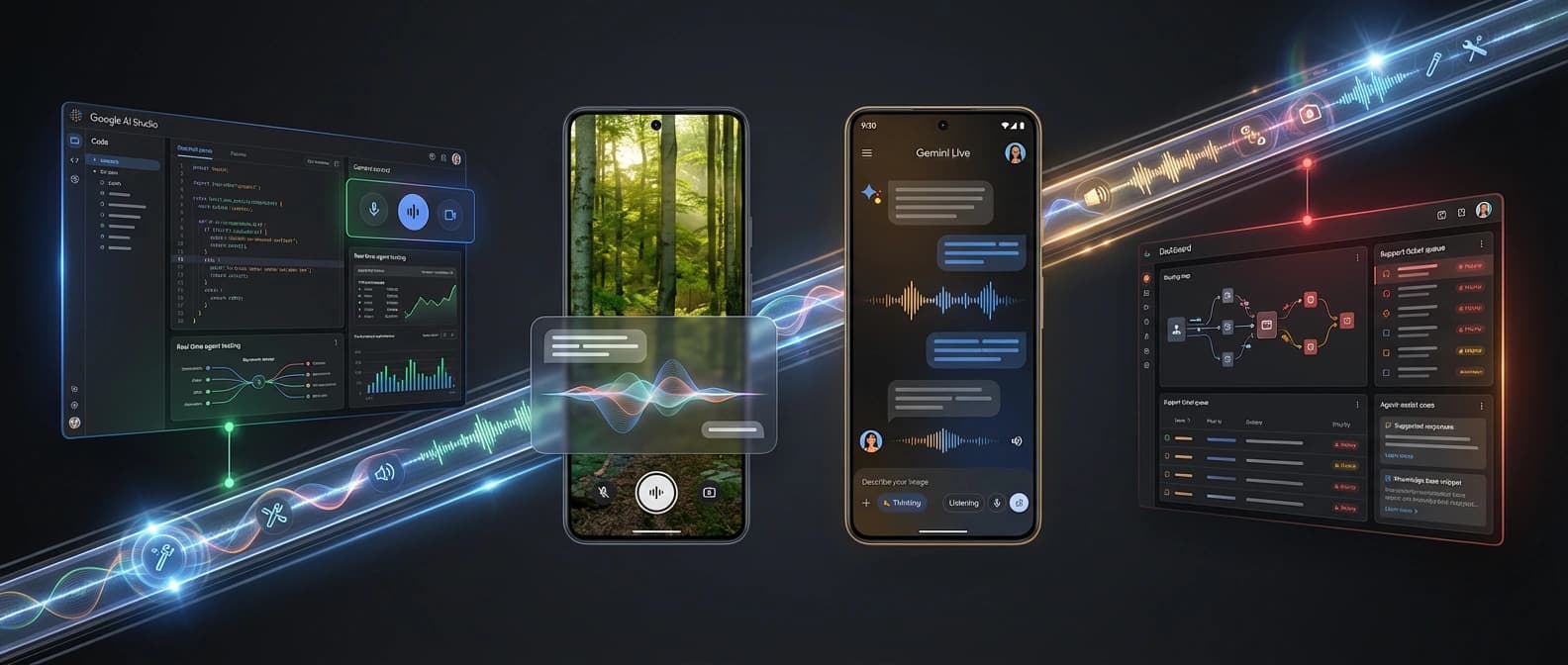
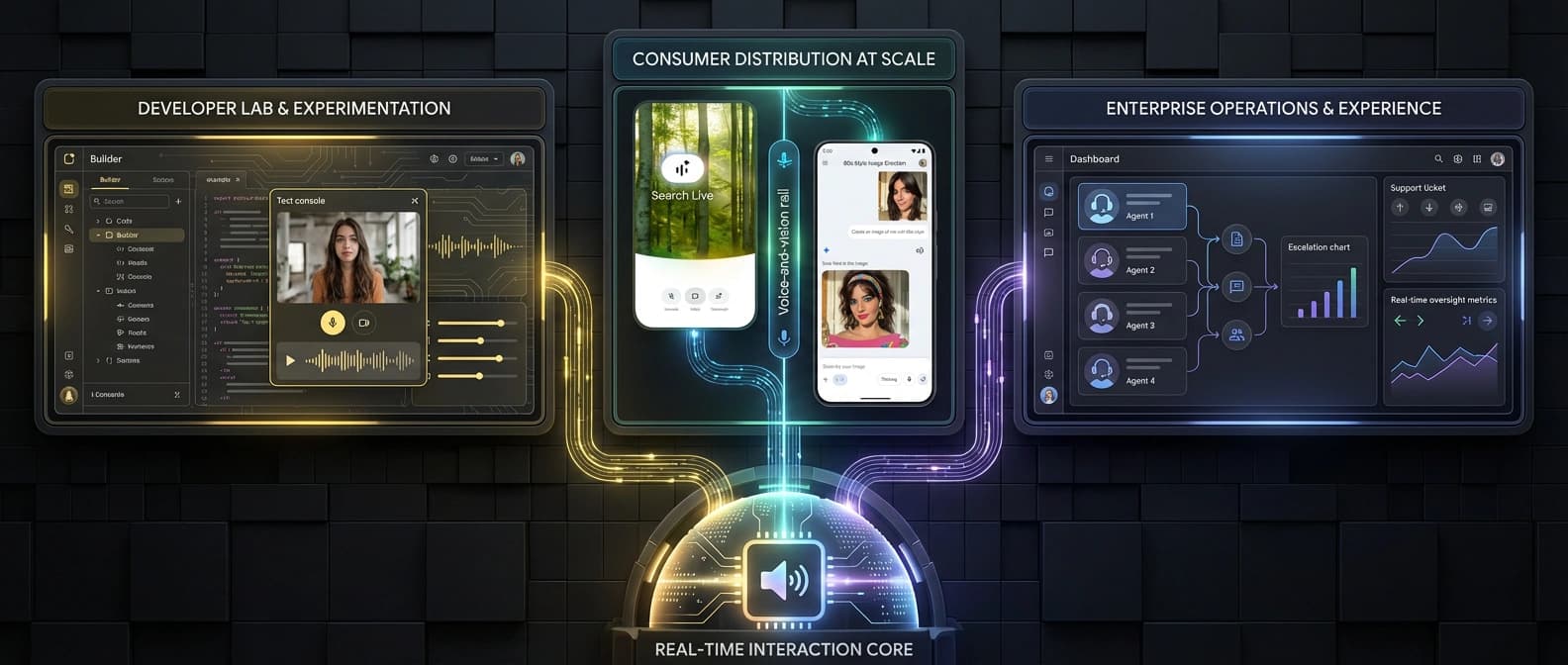
I think Google has built one live interaction rail and is now running several businesses on top of it. Developers get it in AI Studio. Consumers get it through Search Live and Gemini Live. Enterprises get it through customer experience tooling. That is not just model polish. That is distribution architecture.
One live model, four distribution lanes
Google's launch posts are unusually direct about the spread. Developers get Gemini 3.1 Flash Live in preview through the Gemini Live API in Google AI Studio. Consumers get it through Search Live and Gemini Live, with Google saying Search Live is expanding to more than 200 countries and territories where AI Mode is available. Enterprises get it through Gemini Enterprise for Customer Experience.
Those are four very different surfaces doing four very different strategic jobs.
AI Studio is where developers learn Google's preferred workflow and prototype against it. Search Live is where ordinary users start treating live voice-and-camera interaction as a normal part of asking Google for help. Gemini Live is the assistant habit surface. Enterprise CX is the budget-bearing version, where smooth live interaction can turn into a procurement line item instead of a press release.
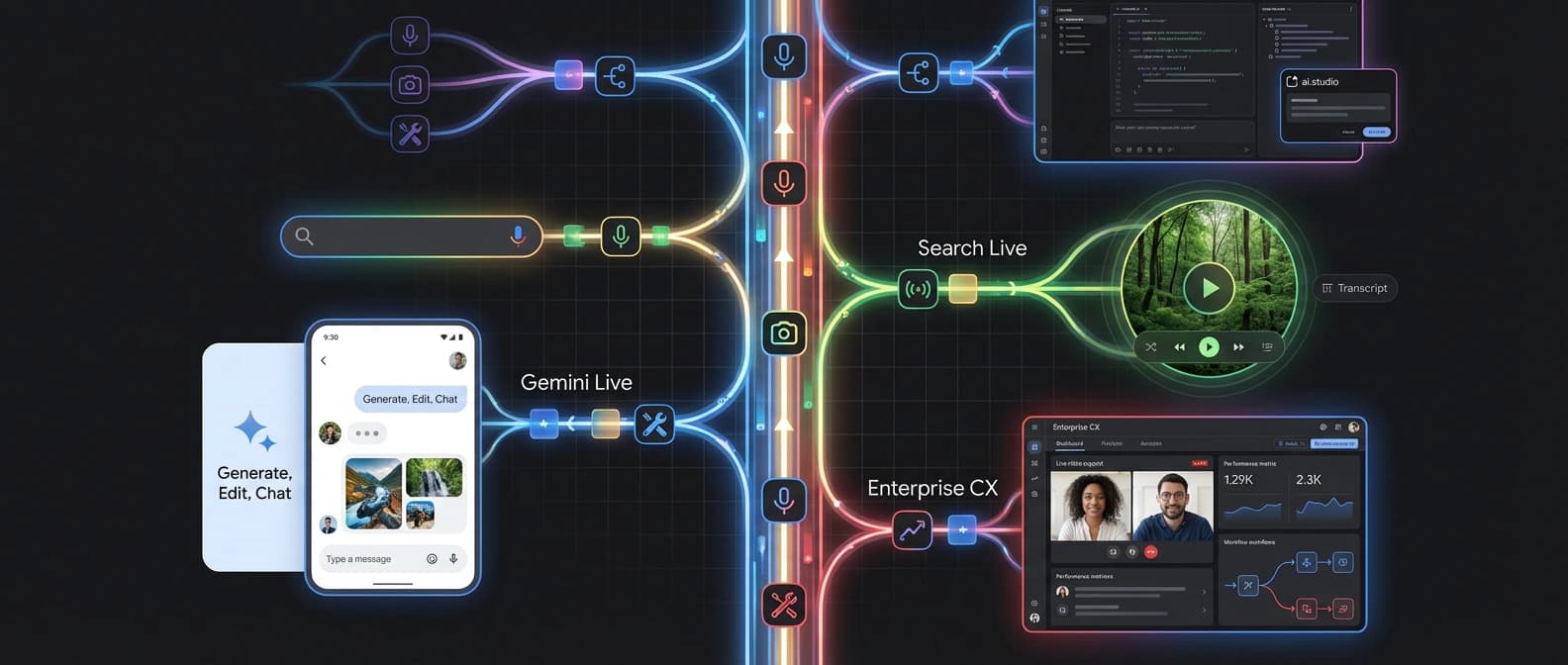
Put differently, Google is laying the same track through the builder surface, the consumer search surface, the assistant surface, and the paid support surface. Most vendors would love to own even two of those lanes. Google has all four, which is why this launch matters more than another round of "our voice is warmer now" copy.
Why Google is really selling a rail, not just a nicer voice
The developer pitch makes that even clearer. Google frames Gemini 3.1 Flash Live as the model for real-time voice and vision agents, not merely as a prettier voice-chat feature. The company highlights lower latency, stronger tool triggering in noisy environments, better instruction following, and support for more than 90 languages in real-time multimodal conversations.
The model card adds the hardware-store label to the box: audio, image, video, and text input; audio and text output; a 128K token context window. None of that makes the product magical. It does make the intent obvious. Google wants developers building agents that can keep a live conversation going while also seeing, hearing, and acting.
That fits neatly with patterns we have already seen in Google AI Studio's full-stack distribution play and in Google's Gemini API control-plane push. The valuable layer keeps moving outward from the model and into the surrounding workflow. Flash Live matters because it gives Google one more shared substrate it can route through several products at once.
Google also brought benchmark numbers, of course. It says Gemini 3.1 Flash Live scores 90.8% on ComplexFuncBench Audio and 36.1% on Scale AI's Audio MultiChallenge with thinking enabled. Useful signals, maybe. But benchmark theater does not stop being theater just because the actors now interrupt each other more smoothly.
Search Live is the distribution tell
The consumer rollout is where the picture really locks in for me.
Search Live is now expanding globally across the places where AI Mode is available, and Google says people in more than 200 countries and territories can use it for voice-and-camera conversations with Search. That 200-plus figure is about geographic reach. The 90-plus language number belongs to the model's multilingual support. Keeping those separate matters because they describe different kinds of scale.
What Google is selling to users is simple: point your camera at a thing, ask a question, and keep talking until the answer gets useful. What Google is building for itself is more interesting: a habit loop where real-time multimodal conversation stops feeling like a special AI demo and starts feeling like part of ordinary search behavior.
That is why this does not read like an isolated model update. Search Live gives Google a mass-distribution lane. Gemini Live gives it an assistant lane. AI Studio gives it a developer lane. Enterprise CX gives it a monetization lane. One subway line, several neighborhoods, and Google is trying very hard to be the transit authority.
What Google still has not solved
This is still not a "voice agents solved" moment. Developer access is in preview. Consumer rollout depends on where AI Mode is available. The enterprise route is specifically tied to Gemini Enterprise for Customer Experience, not some universal drop-in layer every company can deploy tomorrow.
The safety and disclosure story also remains partial. Google says all audio generated by 3.1 Flash Live is watermarked with SynthID, which may help with downstream detection. It does not solve the live human problem. As Ars Technica sensibly noted, watermarking is not much comfort in the moment when a customer assumes the soothing voice on the other end is a person.
So no, this is not AGI with a headset. It is something more practical, and from Google's point of view probably more valuable: one real-time interaction rail spreading across products that reach developers, ordinary users, and enterprise operators at the same time.
That is why I think Gemini 3.1 Flash Live matters. Not because the pauses sound nicer. Because Google is standardizing how live agents get built, distributed, and normalized across its stack.
Source file
Public source trail
These links anchor the package to the underlying reporting trail. They are not a substitute for judgment, but they do show where the reporting starts.
Core launch post covering availability across AI Studio, Search Live, Gemini Live, and enterprise customer experience plus Google's benchmark claims and SynthID watermarking note.
Developer launch post detailing Live API preview access, noisy-environment performance, instruction following, 90-plus language support, and example application patterns.
Confirms Search Live rollout to more than 200 countries and territories in locations where AI Mode is available, with voice and camera interaction in the Google app and Lens.
Model card covering multimodal inputs, token window, outputs, intended usage, evaluation framing, and limits around what the card does and does not claim.
Useful outside read on benchmark context, distribution across Google surfaces, and the practical limit of watermarking for live disclosure.

About the author
Talia Reed
Talia reports on product surfaces, developer tools, platform shifts, category shifts, and the distribution choices that determine whether AI features become durable workflows. She looks for the moment where a launch stops being a demo and becomes an ecosystem move.
- 34
- Apr 1, 2026
- New York
Archive signal
Reporting lens: Distribution is usually the story hiding inside the launch.. Signature: A feature matters when it changes someone else’s roadmap.
Article details
- Category
- AI Tools
- Last updated
- April 11, 2026
- Public sources
- 5 linked source notes
Byline
Covers product surfaces, tools, and the adoption moves that turn AI features into durable habits.