GLM-5.1 hits Hugging Face. Now the scrutiny starts
Z.ai's MIT-licensed GLM-5.1 and GLM-5.1-FP8 checkpoints hit Hugging Face with vLLM and SGLang support, so the benchmark story now has to survive deployment reality.
 ainewssilo.com
The interesting part of GLM-5.1 is no longer the chart. It is the fact that outsiders can finally try to break the chart.
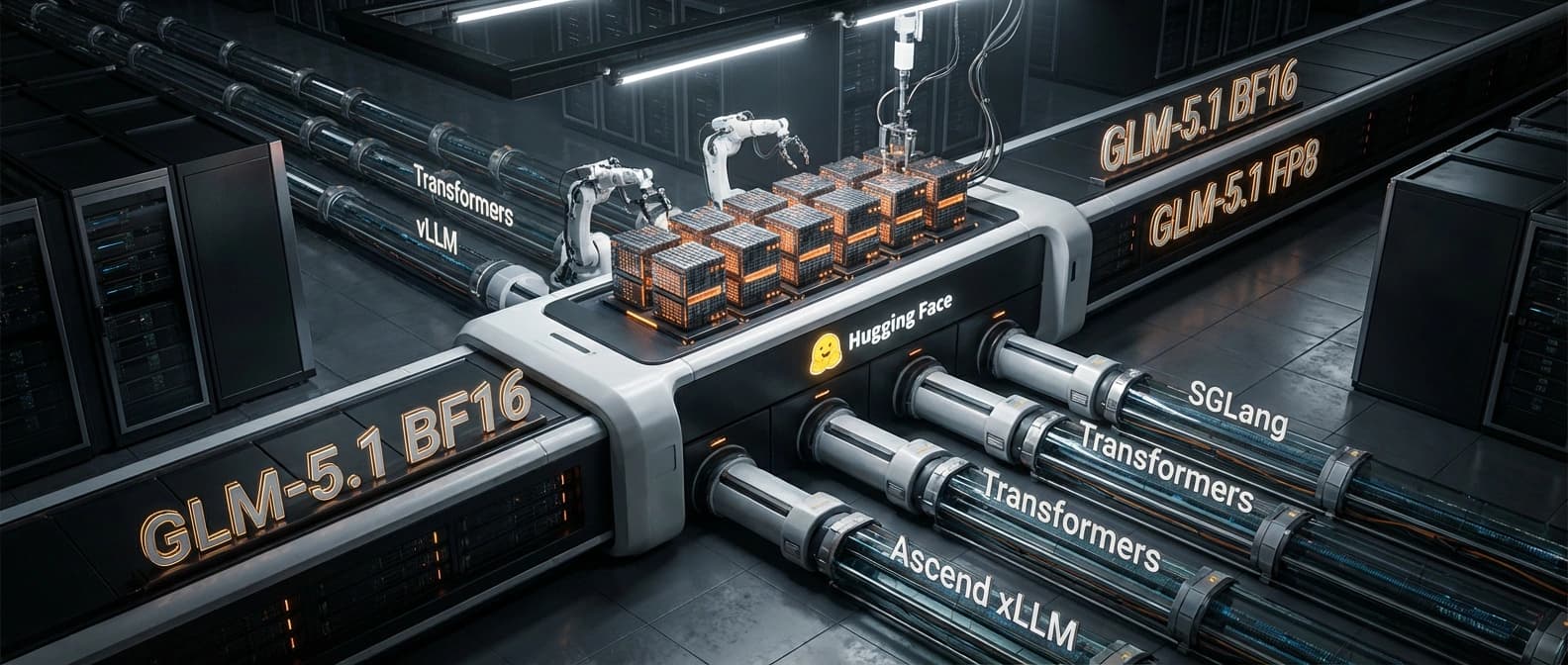
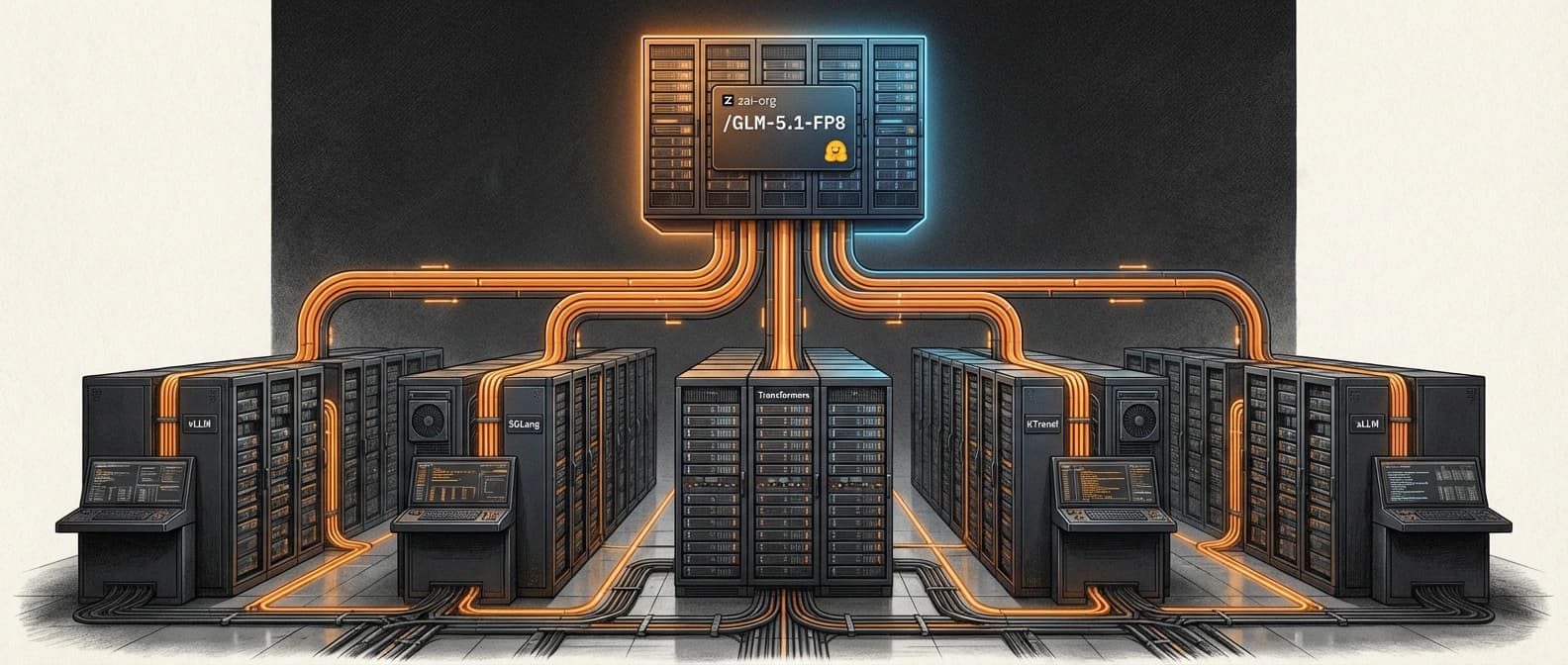
The real GLM-5.1 story did not happen when z.ai posted another model blog. It happened on April 3, when MIT-licensed GLM-5.1 and GLM-5.1-FP8 checkpoints landed on Hugging Face and immediately showed deployer-facing support across vLLM, SGLang, Transformers, KTransformers, and xLLM-linked docs. That changes the conversation fast.
Before that, GLM-5.1 mostly lived in the awkward zone between benchmark brag sheet and workflow promise. We covered that earlier in our piece on GLM-5.1 as a Claude Code and OpenClaw routing play. Now the hook is different. The model is public enough to host, inspect, compare, and distrust with much higher resolution. That is healthy. Benchmark cards need more enemies.
There is still a catch, and it is not a small one. GLM-5.1 is presented as a 744B total, 40B active open-weight model. So yes, the weights are out. No, this does not magically become a weekend laptop toy because a Hugging Face page exists. Open does not mean cheap, and it definitely does not mean light. But public distribution plus a permissive license plus BF16 and FP8 checkpoints is a meaningful shift. It turns GLM-5.1 from an interesting claim into an operator problem.
GLM-5.1 Hugging Face release: what actually changed on April 3
The timing matters because it is the cleanest way to separate the earlier launch framing from the actual open-weight event.
Hugging Face's model API shows zai-org/GLM-5.1 was created on 2026-04-03T09:28:47Z and zai-org/GLM-5.1-FP8 followed 17 seconds later. Both model pages still show fresh edits on April 7. The GitHub repo was moving at the same pace. The zai-org/GLM-5 README had April 7 commits, including an update about vLLM speculative-token settings. In other words, this was not a dusty archive dump. It was a live release still being tightened in public.
That is the real break from the March workflow story. Back then the interesting question was, "Can z.ai slip GLM-5.1 into familiar coding-agent tools?" Now the question is, "What happens when outsiders can pull the weights, wire up serving, and check whether the benchmark pitch survives contact with infrastructure?"
The answer starts with a simple but important clarification. MIT-licensed weights are not the same thing as fully open training data, fully open code, or full reproducibility. The weights are open enough to host and audit in practice. That is already valuable. It is also not the same as handing over the whole factory.
There is one more detail worth keeping straight. The GitHub README says GLM-5.1 will be available on chat.z.ai in the coming days. That phrasing matters because it means the Hugging Face release is the immediate public event, not some already-finished consumer rollout. If you blur those together, you start inventing certainty the source does not give you.

GLM-5 vs GLM-5.1: the weights are new, the size class is not
One easy mistake here is to treat GLM-5.1 like a wholly separate model family with a wholly separate technical story. The public materials do not support that. They support something narrower.
The GitHub repo is titled "GLM-5.1 & GLM-5", and the download table lists GLM-5.1 and GLM-5.1-FP8 beside the earlier GLM-5 and GLM-5-FP8 checkpoints. The framing from z.ai's blog is that GLM-5.1 is the refreshed flagship for agentic engineering, not that the company has published a brand-new standalone technical paper just for this dot release. That distinction matters because it keeps the story honest. This is a public release and a model refresh, not a magical second founding of mathematics.
What changed, then?
Part of it is distribution. GLM-5 existed as a technical and vendor-documented story already. GLM-5.1 on Hugging Face turns that into a much broader testing surface.
Part of it is packaging. The presence of both BF16 and FP8 checkpoints tells you z.ai is not only chasing leaderboard screenshots. It is trying to make the model feasible in more real serving stacks, where precision format can decide whether a deployment plan is plausible or merely aspirational.
And part of it is positioning. GLM-5.1 is aimed squarely at the coding and agentic workflow lane where models like Qwen3.6-Plus and the newer DeepSeek stack are already being judged not only by quality, but by whether operators can run them without sacrificing a small moon.
GLM-5.1 benchmarks: where the claims look useful, and where they still smell like house numbers
The benchmark table on the GLM-5.1 model card is worth reading, but it is not worth worshipping. It is still vendor-published evidence. That does not make it fake. It does mean you should read it like a menu photo, not a biopsy.
A few rows are genuinely informative because they show what improved versus GLM-5 and what did not.
| Benchmark | GLM-5.1 | GLM-5 | Why it matters |
|---|---|---|---|
| HLE | 31.0 | 30.5 | A mild bump, not a revolution |
| HLE (with tools) | 52.3 | 50.4 | Better tool-use framing, which fits the agentic-coding pitch |
| AIME 2026 | 95.3 | 95.4 | Basically flat, which is a good reminder that this is not a broad math leap |
| Terminal-Bench 2.0 (best self-reported) | 37.5 | 32.0 | Stronger agentic-computer-use story, but still self-reported |
| SWE-Bench Pro | 59.1 | 51.0 | Real-looking jump on software tasks, and the sort of row deployers will care about most |
| NL2Repo | 30.1 | 24.3 | Another meaningful coding-repo gain, again from z.ai's own table |
That pattern is more believable than a table where every number jumps in perfect harmony like a synchronized swim team. GLM-5.1 looks like a model refresh tuned to do better on the software and agentic side, not like a universal leap across every cognitive dimension.
I actually trust the story more because AIME is flat. If even the launch card cannot find a clean win there, the table reads less like pure cosmetics.
Still, caution is mandatory. Some of the most flattering rows are the ones that need the most outside replication. Terminal benchmarks, repo-scale coding tasks, and vending-style agent tasks can be informative, but they are also easy places for setup differences to do a lot of quiet work. This is exactly why public checkpoints matter. The benchmark argument is now testable by people who do not work for z.ai.
That is the part I keep coming back to. Open weights do not settle the benchmark debate. They finally make the debate less theatrical.
GLM-5.1 deployment support is real, but the hardware bill did not get the memo
The deployer-facing part of the release is what makes this piece worth writing now.
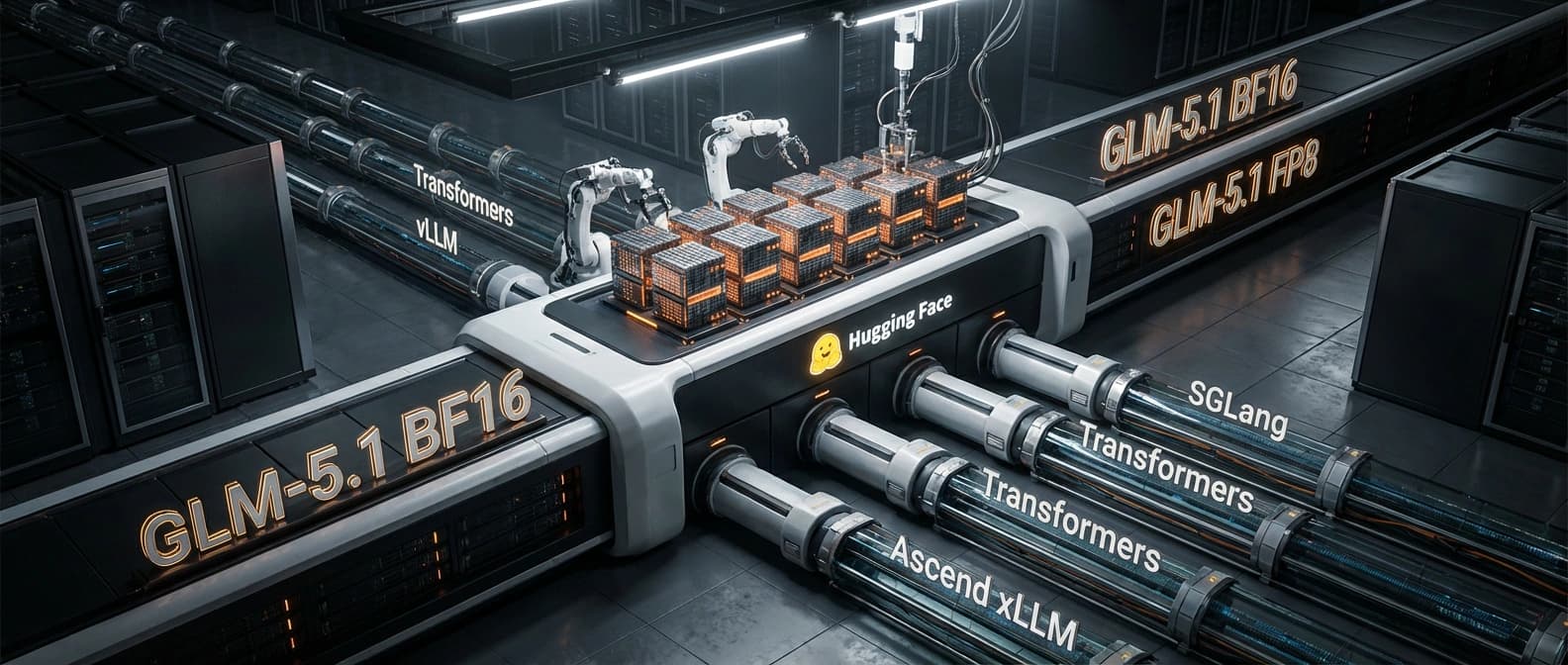
The GLM-5.1 model card lists direct support or guidance for SGLang, vLLM, Transformers, and KTransformers. The GitHub README adds an xLLM deployment path for Ascend-oriented setups. That matters because it means operators do not need to reverse-engineer a weird custom runtime before they can start testing. The road is not frictionless, but at least it exists.
The vLLM recipe makes the tradeoff plain. Its examples for GLM-5.1-FP8 use eight-way tensor parallelism. That is not a sign of a tiny local model sneaking onto your gaming laptop while the fan politely whispers. That is a sign that GLM-5.1 is public, but still very much a big-system model. If you want the cost-side version of the same lesson, our piece on open-weight inference economics explains why a permissive license does not cancel the hardware bill.
A simple table helps separate the open-weight excitement from the practical hosting reality:
| Asset | What became public | Why operators care | Practical catch |
|---|---|---|---|
| GLM-5.1 | MIT-licensed BF16 checkpoint on Hugging Face | Maximum fidelity to the flagship release | Heavy memory and serving footprint |
| GLM-5.1-FP8 | MIT-licensed FP8 checkpoint on Hugging Face | More realistic inference path for serious serving stacks | Still assumes substantial multi-GPU infrastructure |
| vLLM recipe | Public recipe for GLM-5.1 and FP8 serving | Fastest path to "can I actually host this?" | Example setup already tells you this is not a cheap toy |
| SGLang and KTransformers support | More runtime choices from day one | Lowers integration friction and expands the testing pool | Support existing is not the same as support being painless |
| xLLM / Ascend path | Signals ambition beyond Nvidia-default hosting | Relevant for Chinese stack positioning and non-CUDA deployment | Niche path for most Western operators today |
That last row matters more than it first appears. GLM-5.1 is not just trying to sit beside Qwen and DeepSeek on one benchmark slide. It is trying to be legible across multiple deployment ecosystems, including the Chinese infrastructure stack we touched on in our look at DeepSeek V4 and Huawei's AI stack.
This is where the Hugging Face release starts to look strategic. Public distribution plus runtime support plus FP8 packaging is how a model stops being a national-tech curiosity and starts becoming something operators can slot into procurement conversations, cost spreadsheets, and a few regrettable weekend experiments.
GLM-5.1 versus Qwen and DeepSeek now becomes a real hosting argument
Before April 3, GLM-5.1 mostly competed as a claim. After April 3, it competes as a deployment option.
That does not mean it wins. Qwen and DeepSeek still have deeper public familiarity, broader grassroots testing, and in some cases a stronger head start in the open-model community. It does mean GLM-5.1 joins the more serious tier of Chinese open-weight competition where the questions get harder and more useful.
Can operators run it through familiar stacks? Yes, at least on paper and increasingly in practice.
Can they compare BF16 and FP8 routes? Yes.
Can they stop treating the benchmark card as sacred text and start checking behavior themselves? Also yes.
That is why this Hugging Face moment matters more than another chart. A chart tells you what the vendor wants you to believe. A public checkpoint tells you what the rest of the market is allowed to investigate.
If GLM-5.1 holds up under broader testing, z.ai gets a much stronger claim to be in the same serious open-model conversation as Qwen and DeepSeek. If it does not, the market will find that out faster too. Either outcome is better than staring at polished leaderboard tables until everyone goes cross-eyed.
Here is the part that sticks with me: GLM-5.1 became a real open-weight story on April 3, not because the benchmarks changed, but because the right to question the benchmarks got distributed. That is a much bigger deal than it sounds.
Source file
Public source trail
These links anchor the package to the underlying reporting trail. They are not a substitute for judgment, but they do show where the reporting starts.
Main public model page for the MIT-licensed BF16 checkpoint, benchmark table, support list, and launch framing.
Companion public model page for the FP8 checkpoint that turned the release into a more practical serving story.
Used for created-at and last-modified timestamps showing the April 3 release and April 7 updates.
Used for the FP8 checkpoint's April 3 creation timestamp and April 7 update history.
Repository source for the public download table, deployer-facing README, chat.z.ai availability note, and links to vLLM, SGLang, KTransformers, and xLLM deployment paths.
Independent deployment recipe showing GLM-5.1 and GLM-5.1-FP8 serving paths, including eight-way tensor parallel examples.
Official launch framing for GLM-5.1 as the refreshed agentic-engineering model, useful to compare with the later open-weight release.
Shows README edits still landing on April 7, including deployment-guide changes after the Hugging Face release.

About the author
Idris Vale
Idris writes about the institutional machinery around AI, but the lens is broader than policy alone: procurement frameworks, public-sector buying rules, platform leverage, compliance burdens, workflow risk, and the market structure hiding beneath product or infrastructure headlines. The through-line is practical power, not abstract theater.
- 23
- Apr 10, 2026
- Brussels · London corridor
Archive signal
Reporting lens: Follow the buying process, not just the bill text.. Signature: Policy turns real when someone has to buy the system.
Article details
- Category
- Open Source AI
- Last updated
- April 11, 2026
- Public sources
- 8 linked source notes
Byline
Tracks the institutions, incentives, and market structure that quietly decide which AI systems get deployed and why.