Signed reporting across six AI categories, built to keep the archive useful after the launch noise burns off.

Edition brief6 AI categories/Stable category archives/Machine-readable discovery
Open Source AISigned reporting
Published March 23, 2026

NVIDIA OpenShell makes agent security an infrastructure layer

OpenShell matters less as another framework than as a control plane that moves policy, sandboxing, and model routing outside the agent’s reach.

Lena OrtizStaff Writer8 min read
The interesting move is not the agent itself. It is the decision to put the rules somewhere the agent cannot rewrite.
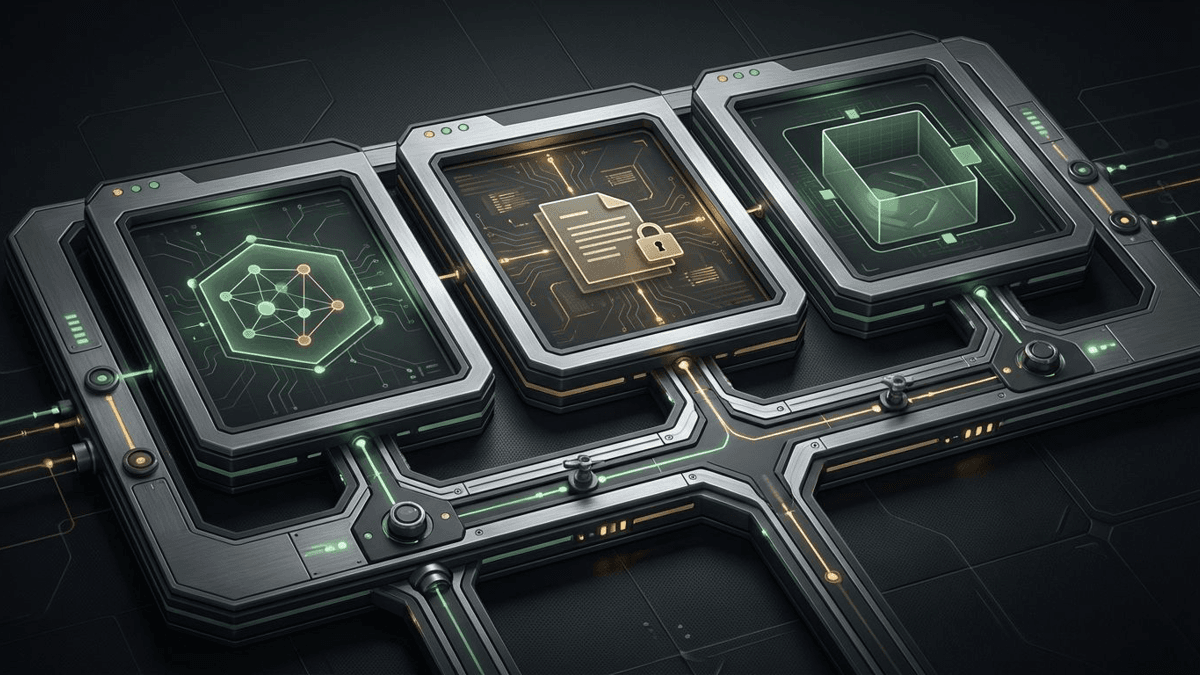
Editorial illustration of isolated agent workspaces running inside tab-like sandboxes while an external runtime policy layer governs file access, network routes, and model routing.
Open Source AICover / Open Source AI

Lead illustration

NVIDIA OpenShell makes agent security an infrastructure layer
Cover / Open Source AIOpenShell’s pitch is simple: the last word on what an agent can touch should live outside the agent itself.

The interesting thing about NVIDIA OpenShell is that it treats agent safety as a placement problem.

Not “write a stricter system prompt.” Not “hope the model remembers the rules.” Put the rules somewhere the agent cannot rewrite them, then let the agent operate inside boundaries enforced by the runtime itself.

That sounds almost boring. It is also a much more serious answer to the agent-security problem than most launch-day copy. We already argued in AI’s new battlefront is action, not answers that the market is shifting toward systems that can actually do things: use tools, touch files, route across services, and keep working after the human stops typing. Once that happens, the old safety story starts to look thin. A long-running agent with shell access, live credentials, package installs, and permission to spawn subagents is not just a chat interface with extra steps. It is a new operational surface.

NVIDIA’s answer is OpenShell, an open-source runtime that sits between the agent and the underlying infrastructure. The company’s developer write-up describes three core pieces: an isolated sandbox, a policy engine, and a privacy router. The GitHub README makes the same architecture more concrete. Sandboxes start with minimal outbound access. Policies are declarative YAML. Network and inference rules can be hot-reloaded. Filesystem and process constraints are locked at sandbox creation. The result is an AI agent sandbox where the agent can keep working, but the final enforcement point sits outside the agent process.

That is why OpenShell matters. It is less another agent framework than a real attempt at an AI agent control plane.

The weak point in most agent stacks is where the guardrails live

The sharpest line in NVIDIA’s developer post is the one that says today’s agent runtimes resemble the early web: powerful, but missing core security primitives like isolation, permissions, and sandboxing. That feels about right.

A lot of current agent tooling still assumes the model, the harness, and the guardrails can live more or less in the same place. The system prompt tells the model what not to do. The tool wrapper asks for approvals. The application layer tries to stop bad behavior after the model has already reasoned its way into danger. That can be good enough for short, heavily supervised sessions. It is a shaky foundation for secure autonomous AI agents that are supposed to run for hours, evolve their own workflows, and touch real systems.

NVIDIA is not subtle about the failure mode. In its own description, the risky version is an agent “policing itself,” with guardrails living inside the same process they are supposed to guard. Prompt injection, skill installation, or a bad tool chain can turn that into a mess quickly because the thing being controlled is too close to the control logic.

That is where OpenShell’s “browser tab” analogy earns its keep. The company says each agent session gets its own isolated environment, and the runtime verifies permissions before actions execute. The point is not the metaphor. The point is the boundary.

Editorial diagram showing several isolated agent sandboxes arranged like browser tabs, with an external runtime layer controlling what each sandbox can access.
Figure / 01 The browser-tab comparison is the point: each agent gets its own bounded workspace, and the control logic sits outside the workspace.

Browsers became safer when web pages stopped being allowed to treat the whole machine as one flat trust zone. OpenShell is trying to do the same move for agents. Each sandbox gets its own resource boundaries. Network access is not assumed. Filesystem and process rules are constrained up front. The policy layer is the thing saying yes or no, not the agent talking to itself.

That does not make agents safe by magic. It does change the conversation from “How clever are the prompts?” to “Where does enforcement actually live?” That is a much better question.

OpenShell’s real move is out-of-process enforcement

The most important architectural decision here is what NVIDIA calls out-of-process policy enforcement. That sounds abstract until you read the repo examples.

In the README quickstart, a fresh sandbox cannot even curl the GitHub API. After a policy update, read-only GET requests are allowed while POST requests are still blocked at the proxy layer. The policy engine evaluates access at a surprisingly granular level: binary, destination, method, and path. That is a stronger story than vague talk about “guardrails.” It is runtime policy with teeth.

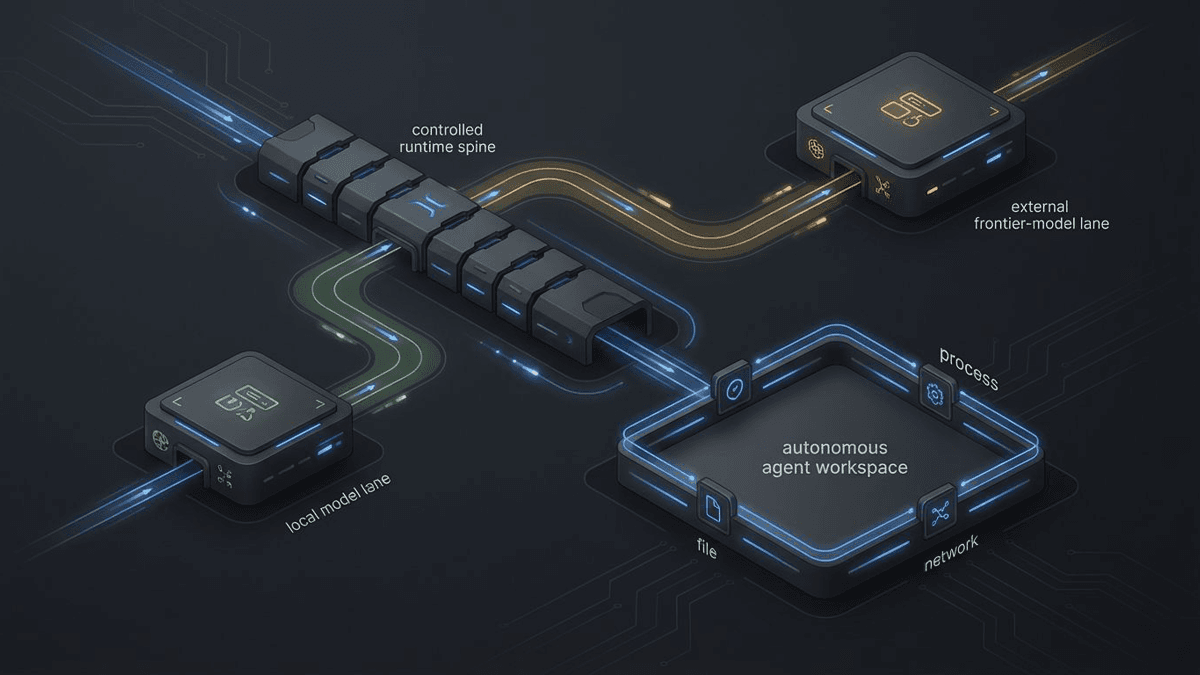
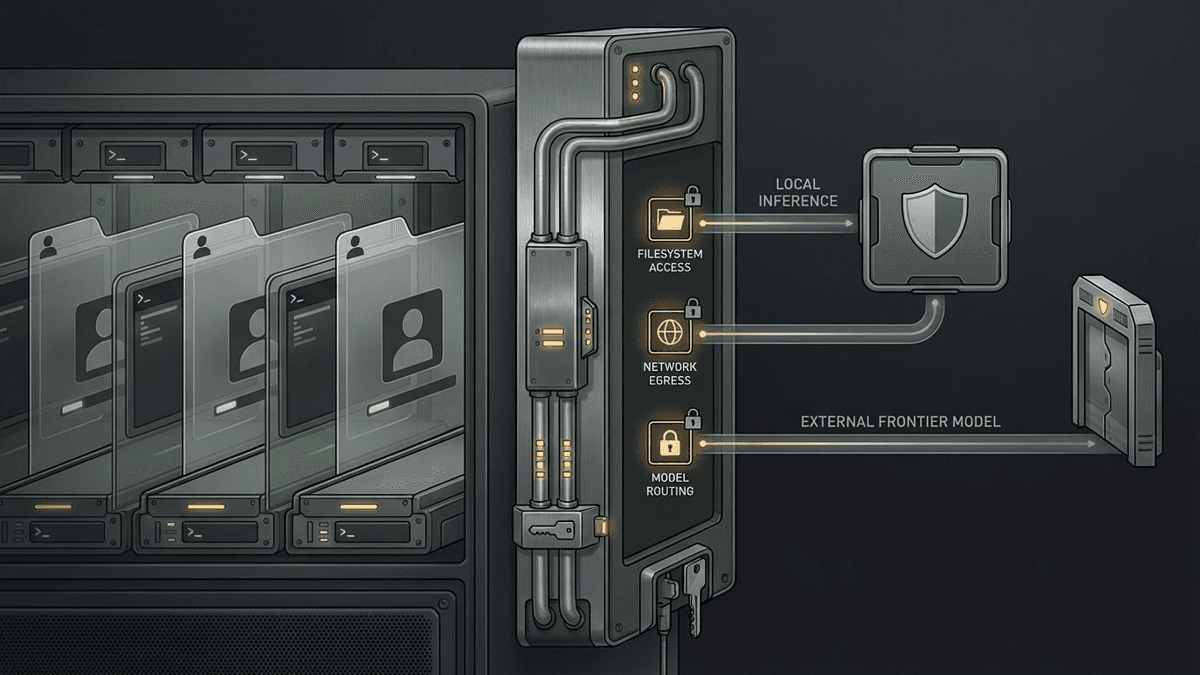
The same pattern shows up in credential handling and model routing. OpenShell manages credential bundles as providers and injects them at runtime rather than storing them in the sandbox filesystem. Its privacy router is supposed to keep sensitive context on local compute and route to outside frontier models only when policy allows. That matters because agent runtime security is not just about preventing a dangerous shell command. It is also about deciding who gets to see context, which model handles it, and whether the agent gets any say in that decision.

That is the real difference between OpenShell and a lot of current agent-platform messaging. Stories like OpenAI’s agent stack is a distribution play, not a demo are about workflow ownership: models, tools, traces, evals, deployment. OpenShell is chasing a different layer. It is trying to become the enforcement surface around the workflow. You can see a similar control-plane instinct in Google’s Gemini tooling update, but NVIDIA is pushing the idea into runtime security much more explicitly.

Editorial diagram showing an agent runtime policy layer splitting local model traffic from external model traffic while separately governing file and network permissions.
Figure / 02 OpenShell’s claim is not just sandboxing. It is that privacy, network, and inference decisions should be enforced by the runtime rather than by the agent’s own prompt logic.

That is why the project feels more important than a simple launch brief suggests. If serious teams really want long-running agents in production, they will eventually need to separate agent behavior from policy definition and policy enforcement. OpenShell is one of the clearest attempts to make that separation the product.

This is a real repo, not just a keynote concept, but it is still early

There is enough substance here to take the project seriously. The repo is public under Apache 2.0. It supports familiar agent surfaces including Claude Code, Codex, Copilot, OpenCode, and community sandboxes such as OpenClaw. The GitHub API shows the project was created on Feb. 24, has roughly 3,400 stars and 343 forks, and was still being pushed today. That is not proof of adoption, but it is enough to show OpenShell is live, active, and getting attention.

At the same time, the README goes out of its way to cool the hype down. It calls OpenShell “Alpha software — single-player mode” and describes the current release as “proof-of-life: one developer, one environment, one gateway.” That is the kind of caveat more launch posts should include.

So the honest read is mixed in a good way. The architecture is real. The repo is real. The policy examples are real. The enterprise story is still ahead of the software.

That is also where the Cisco announcement belongs. Cisco says its new DefenseClaw framework will hook into OpenShell as part of a broader push around agent identities, zero-trust access, and runtime guardrails. Treated carefully, that is useful signal. It says runtime enforcement for agents is becoming a live enterprise security category. It does not prove OpenShell has already won that category. If anything, it shows how open the field still is.

The other reason not to overclaim is that runtime security is only one piece of a deployable agent stack. Better post-training and evaluation still matter. We made that case in Together AI fine-tuning makes post-training the agent reliability layer. But model reliability and runtime policy solve different problems. One helps the agent behave better. The other helps contain damage when behavior is not enough.

Why this matters beyond NVIDIA

The broader takeaway is not “NVIDIA launched another framework.” It is that the agent market is finally being forced to admit where trust has to come from.

If agents are going to keep gaining autonomy, the permission model cannot stay inside the agent. The same way open-source security funding started looking like infrastructure spend once AI increased pressure on maintainers, agent safety starts looking like infrastructure once the agent can keep acting without constant human supervision. That is what OpenShell gets right.

The bet may or may not pay off for NVIDIA specifically. But the design move is hard to ignore. Put the sandbox outside the agent. Put policy outside the agent. Put model-routing decisions outside the agent. Make the runtime, not the reasoning loop, hold the keys.

If that idea sticks, OpenShell will matter even to teams that never adopt it directly, because other runtimes will have to answer the same question: when the agent wants more reach, who gets the last word?

Right now, that is still the live issue. And OpenShell is one of the few open projects trying to answer it with infrastructure instead of vibes.

Source file

Public source trail

These links anchor the package to the underlying reporting trail. They are not a substitute for judgment, but they do show where the reporting starts.

Primary sourceblogs.nvidia.comNVIDIA Blog
How Autonomous AI Agents Become Secure by Design With NVIDIA OpenShell

NVIDIA’s higher-level framing for OpenShell, including the browser-tab analogy and the argument for system-level policy enforcement.

Primary sourcedeveloper.nvidia.comNVIDIA Developer Blog
Run Autonomous, Self-Evolving Agents More Safely with NVIDIA OpenShell

Primary source for the architectural description: sandbox, policy engine, privacy router, and the out-of-process enforcement thesis.

Primary sourcegithub.comGitHub
NVIDIA/OpenShell

Public repo source for the alpha-stage README, policy examples, supported agent integrations, and the project’s own maturity caveats.

Primary sourceapi.github.comGitHub API
NVIDIA/OpenShell repository metadata

Confirms repository activity, creation date, current push date, license, and public adoption signals such as stars and forks.

Supporting reportingnewsroom.cisco.comCisco Newsroom
Cisco Reimagines Security for the Agentic Workforce

Useful as ecosystem signal that runtime guardrails and zero-trust controls for agents are becoming a live enterprise security category, not as proof of OpenShell adoption.

Portrait illustration of Lena Ortiz

About the author

Lena Ortiz

Staff Writer

View author page

Lena tracks the economics and mechanics behind AI systems, from serving architecture and open-weight deployment to developer tooling, platform shifts, product decisions, and the operational tradeoffs that shape what teams actually run. Her reporting is aimed at builders and operators deciding what to trust, adopt, and maintain.

Published stories
7
Latest story
Mar 23, 2026
Base
Berlin

Reporting lens: Operating leverage beats ideological posturing.. Signature: If the cost curve moves, the product strategy moves with it.

Related reads

More reporting on the same fault line.

Open Source AI/Mar 23, 2026/7 min read

vLLM Triton attention backend makes AMD more credible in inference

vLLM's Triton and ROCm attention work points to a new inference contest: portable backends that can make AMD and other non-NVIDIA stacks credible in production.

Editorial illustration of a portable attention layer spanning several GPU rack lanes, with one AMD ROCm path showing extra acceleration inside the shared inference stack.
Open Source AIFiled / MAR 23, 2026

Lead illustration

vLLM Triton attention backend makes AMD more credible in inferenceRead vLLM Triton attention backend makes AMD more credible in inference
Filed / MAR 23, 2026The strategic shift is not that vendor-specific tuning disappeared. It is that portable attention layers now decide whether more than one hardware stack can even compete.
Open Source AI/Mar 23, 2026/7 min read

Open source security funding just became AI supply-chain defense

The Linux Foundation’s $12.5 million coalition shows AI labs now need open source maintainers to handle a rising flood of AI-generated security findings.

Editorial illustration of an AI software stack resting on an open source maintainer layer as security findings pour downward and funding flows back up.
Open Source AIFiled / MAR 23, 2026

Lead illustration

Open source security funding just became AI supply-chain defenseRead Open source security funding just became AI supply-chain defense
Filed / MAR 23, 2026The money matters, but the real story is where it is going: back into the maintainers and workflows that AI labs quietly depend on.
Open Source AI/Mar 13, 2026/7 min read

Open-weight model inference economics for lean teams

Open-weight inference economics hinge on utilization, latency, privacy, and operational control, not just sticker price or ideology about self-hosting.

Editorial illustration of a serving stack with model weights, GPU capacity, utilization lines, and cost panels arranged across a dark model-serving grid.
Open Source AIFiled / MAR 13, 2026

Lead illustration

Open-weight model inference economics for lean teamsRead Open-weight model inference economics for lean teams
Filed / MAR 13, 2026The economics of open-weight serving are decided by utilization and operations, not ideology alone.
NVIDIA OpenShell makes agent security an infrastructure layer | AI News Silo