Google's Veo 3.1 Lite starts a video price war
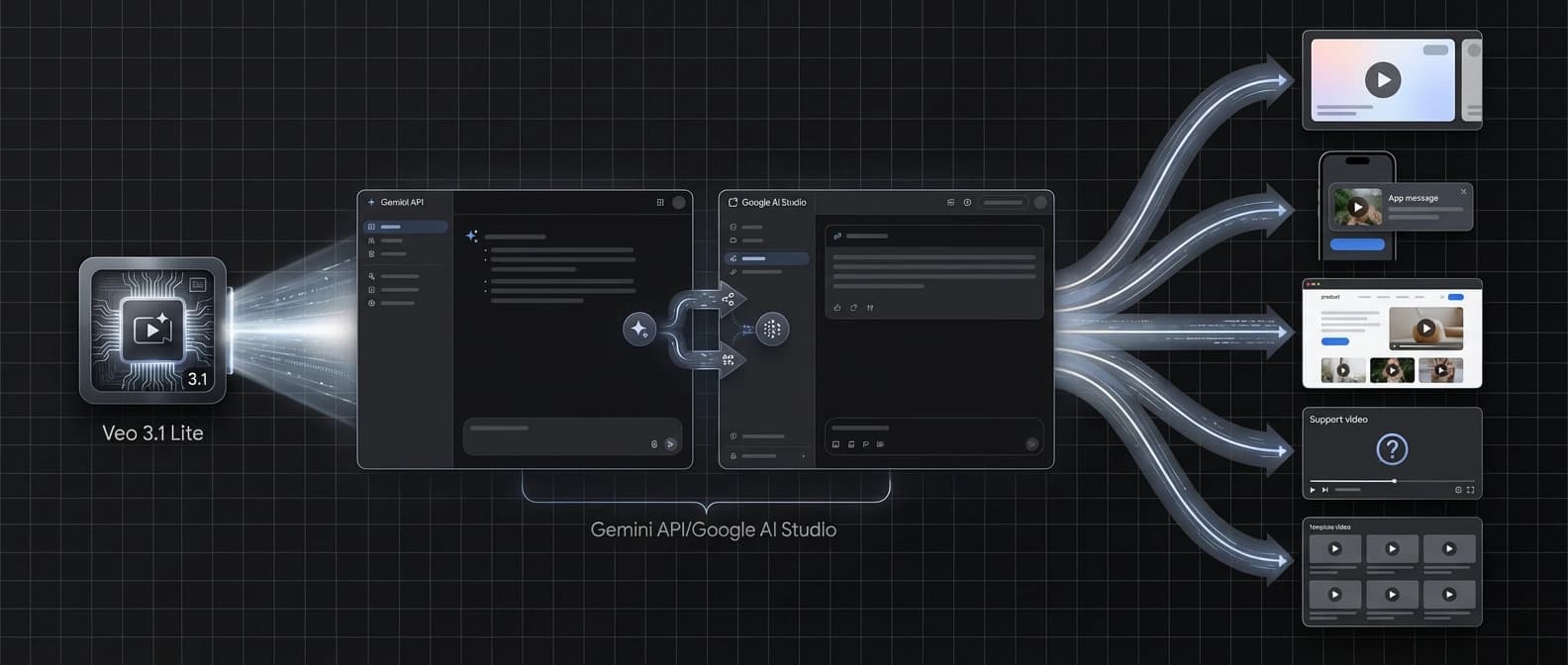
Veo 3.1 Lite is less a flashy model launch than a cheaper video line item inside Gemini API and AI Studio. Google is turning AI video into normal developer spend.

 ainewssilo.com
The real launch is not a new demo reel. It is Google turning AI video into a cheaper API line item, which is a much scarier sentence for rivals.
Google's newest Veo launch is easy to misread if you stare at the sample clips too long. The important thing is not that Google has another video model. Big tech companies release model tiers the way fast-food chains release sauces. The important thing is that Veo 3.1 Lite showed up today as a cheaper option inside the Gemini API and Google AI Studio, with Google already telling developers that Veo 3.1 Fast gets cheaper again on April 7.
That is not housekeeping. That is pricing pressure.
I think Google is making AI video boring on purpose, and I mean that as a compliment. After the standalone-app theater around products like Sora, the sharper move is to make video generation feel like an ordinary developer purchase: a model, a rate card, a workflow, and one less reason to leave your existing stack. That matters even more after the wobblier consumer-video story around OpenAI's Sora shutdown and the broader Sora retreat fallout.
What Google actually launched today
Veo 3.1 Lite does text-to-video and image-to-video, but keep your ambitions to 8 seconds
Google's launch post says Veo 3.1 Lite supports text-to-video and image-to-video, in landscape or portrait, at 720p and 1080p. Clip lengths come in 4, 6, or 8 seconds. That is enough for ads, product loops, short social inserts, and the kind of synthetic b-roll that keeps growth teams extremely caffeinated.
The model docs are blunter about the limits: Lite is still a preview model, it outputs one video with audio, and it does not support 4K output or extension. So no, this is not the version you buy when you want to moonlight as a film studio. This is the version you buy when you need a lot of short clips and would prefer not to light your budget on fire.
It ships where developers already work: Gemini API paid tier and AI Studio
This part matters more than the spec list. Google rolled Lite out on day one through the paid tier of the Gemini API and through AI Studio. That makes the launch feel less like a consumer-product event and more like another brick in the same distribution wall Google has been building across developer tools.
That logic matches Google's AI Studio full-stack push and its work to make the Gemini API combine tools, functions, Maps, and grounding more cleanly. Veo 3.1 Lite is not a standalone destination. It is a cheaper video feature wired into places developers already touch.
The pricing is the real story, not the demo reel
Lite, Fast, and Standard now form a very legible video menu
The live pricing page is where the story stops being vague. Veo 3.1 Standard sits at $0.40 for 720p and 1080p video with audio, or $0.60 for 4K. Veo 3.1 Fast sits at $0.15 for 720p and 1080p, or $0.35 for 4K. Veo 3.1 Lite comes in at $0.05 for 720p and $0.08 for 1080p, with no 4K support.
That gives Google a price ladder that almost reads like a dare. Lite is the low-cost volume lane. Fast is the mid-tier workhorse. Standard is the premium lane. The launch post says Lite costs less than half as much as Fast while keeping the same speed. The posted rate card clearly backs the spirit of that claim at 720p, where Lite is one-third the price of Fast. At 1080p the gap is still meaningful, just a little less dramatic than the clean marketing line. Which is also very corporate: the adjectives arrive wearing better clothes than the footnotes.

The April 7 Fast cut is why this looks planned, not accidental
If Lite were the only change, you could call this normal SKU tidying and move on. But Google also says Fast pricing drops on April 7 to $0.10 for 720p, $0.12 for 1080p, and $0.30 for 4K.
That is why this looks like a market move. Lite establishes a cheaper floor today. Fast gets harder to undercut next week. Standard still preserves a higher-end tier above both. That is how you reset a category without saying, “hello, we are resetting the category.” Launch posts prefer phrases like “more flexibility for builders,” which is true in the same way a supermarket price war is “more flexibility for dinner.”
After Sora's retreat, Google is making AI video boring on purpose
This is an API distribution move, not a standalone creative toy
The AI video market has been wobbling between two identities. One is the sexy consumer app: polished feed, creator buzz, cinematic branding. The other is the duller but stronger one: an API surface that quietly becomes part of ad tools, ecommerce workflows, education products, and enterprise media plumbing.
Google is leaning into the second version. I think that is the smarter bet. A flashy app can win attention for a quarter. Cheap video generation inside a developer stack can win habits.
The products that just got cheaper to build
Lite makes the most sense anywhere quality can bend a little but throughput matters a lot: product explainers at scale, short ad variants, avatar-led support clips, templated local-business promos, in-app video messages, and lightweight learning content.
If your business depends on every clip looking pristine, Lite may not be your favorite toy. If your business depends on producing a lot of decent clips without making finance call you into a small room, Lite suddenly looks very attractive.
Where Veo 3.1 Lite is obviously constrained
No 4K, no extension, and no proof yet that “same speed” feels the same in practice
There are three caveats nobody should decorate away. Lite tops out at 1080p. The docs say no extension support. And the “same speed” line is Google's claim, not an independent benchmark. Right now there is no public wave of side-by-side testing showing how Lite compares with Fast or Standard on motion quality, prompt adherence, or general weirdness. And AI video still produces weirdness. The medium remains spiritually committed to the occasional cursed hand.
It is also a paid preview, which means the docs can shift and the behavior can shift with them. That does not make the launch unimportant. It just means nobody should confuse a fresh rate card with settled truth.
Cheap and good enough may matter more than best looking
Still, this is why I think the launch matters. Google does not need Lite to be the prettiest model in the family. It needs Lite to be cheap enough, fast enough, and easy enough to plug into existing workflows that builders stop treating AI video like a luxury effect.
That is the wedge. Once video generation becomes a normal API checkbox instead of a precious studio event, the market changes. And when one company can drop a cheaper tier today while pre-announcing another price cut for next week, everyone else gets the memo even if they pretend not to hear it.
The Veo 3.1 Lite story is not “Google made another video model.” It is that Google is trying to make AI video feel like infrastructure. That is a much bigger problem for rivals than one more impressive demo clip.
Source file
Public source trail
These links anchor the package to the underlying reporting trail. They are not a substitute for judgment, but they do show where the reporting starts.
Launch post confirming same-day rollout, same-speed framing, supported durations, resolutions, and Google's claim that Lite lands below Fast on cost.
The live pricing page is the key document for the analysis: Veo 3.1 Lite, Fast, and Standard sit on one visible ladder, and the April 7 Fast cut is already posted.
Confirms model code, text and image inputs, video-with-audio output, and the explicit limits around 4K output and extension.
Soft early community signal only: at capture time the thread had minimal points and no comment discussion, which reinforces how early this story is.

About the author
Talia Reed
Talia reports on product surfaces, developer tools, platform shifts, category shifts, and the distribution choices that determine whether AI features become durable workflows. She looks for the moment where a launch stops being a demo and becomes an ecosystem move.
- 34
- Apr 1, 2026
- New York
Archive signal
Reporting lens: Distribution is usually the story hiding inside the launch.. Signature: A feature matters when it changes someone else’s roadmap.
Article details
- Category
- AI Tools
- Last updated
- April 11, 2026
- Public sources
- 4 linked source notes
Byline
Covers product surfaces, tools, and the adoption moves that turn AI features into durable habits.