OpenAI Is Shutting Down the Sora App. What Survives
OpenAI says goodbye to the Sora app, but its own FAQ, release notes, and video docs still show Sora 2 alive. Here is what is actually shutting down.
 ainewssilo.com
This looks less like a clean product sunset than a badly signposted handoff between old Sora, Sora 2, and whatever OpenAI wants the video business to become next.
I think the simplest Sora headline is also the least accurate one.
OpenAI has said it is “saying goodbye to the Sora app,” and if you stop reading there, it is easy to conclude that Sora is dead. But once I line up OpenAI’s own public materials, the picture gets sloppier. The company is clearly shutting down the standalone app and the social layer around it. At the same time, its docs still describe Sora 2 as the active experience in the United States, recent release notes still mention a new editor, and the developer docs still present Sora video models as live.
That is not a clean funeral. It is a product transition with too many labels on the boxes.
OpenAI is killing the app while Sora 2 still appears in public docs
The strongest evidence for a narrow reading comes from OpenAI itself. The Sora 1 sunset FAQ says Sora 1 was removed in the U.S. on March 13, 2026, and that Sora 2 remains the default Sora experience there. It also says users can keep generating video with Sora 2 after Sora 1 is retired.
That is why I do not think “all of Sora is gone” is a defensible reading yet. What looks clearly dead is the standalone app identity and the social wrapper built around it. The goodbye post on X thanks people who created, shared, and built community around Sora, which sounds very much like a farewell to the feed, the remix culture, and the public posting loop.
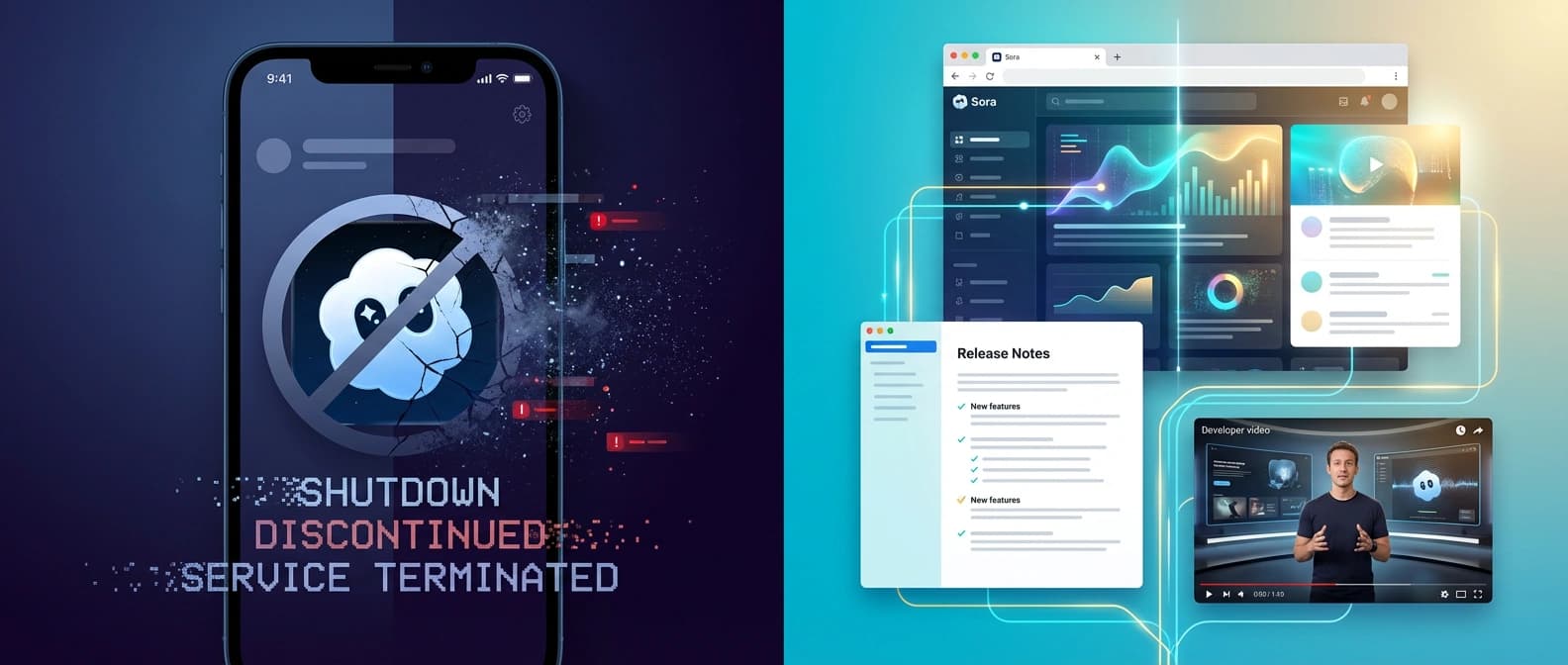
In other words, OpenAI seems to be closing one surface while still leaving traces of another. That can be a sensible internal migration. From the outside, though, it looks like somebody labeled the moving boxes after the truck left.
The API and release notes are why this shutdown story feels messy
The confusion gets worse once you check the rest of OpenAI’s public trail. The getting started with the Sora app page still describes Sora as an app built on “our next-generation model, Sora 2,” with remixing, sharing, following, direct messages, and synchronized audio. The Sora release notes show OpenAI announcing a new editor on March 19, 2026, just days before the goodbye post.
Meanwhile, the developer docs for video generation with Sora still list sora-2 and sora-2-pro as active models for creating, editing, extending, and downloading videos. That does not guarantee those APIs stay forever. The shutdown message explicitly said OpenAI would share more about app and API timelines. But it does mean the public record still points to a living video stack, not a black hole.
This is why the story feels messy. OpenAI may know exactly what it is doing internally. Publicly, though, it has created the software equivalent of finding a restaurant’s “grand opening” banner hanging next to a “thanks for the memories” sign.
What Sora users should preserve right now
For users, the practical issue is not philosophical. It is whether their stuff survives.
The Sora 1 sunset FAQ says older generations and social activity, including likes and remixes, will not be available after Sora 1 is retired. It also warns that data export may remain available only for a limited time before permanent deletion. That is the part I would treat as urgent.
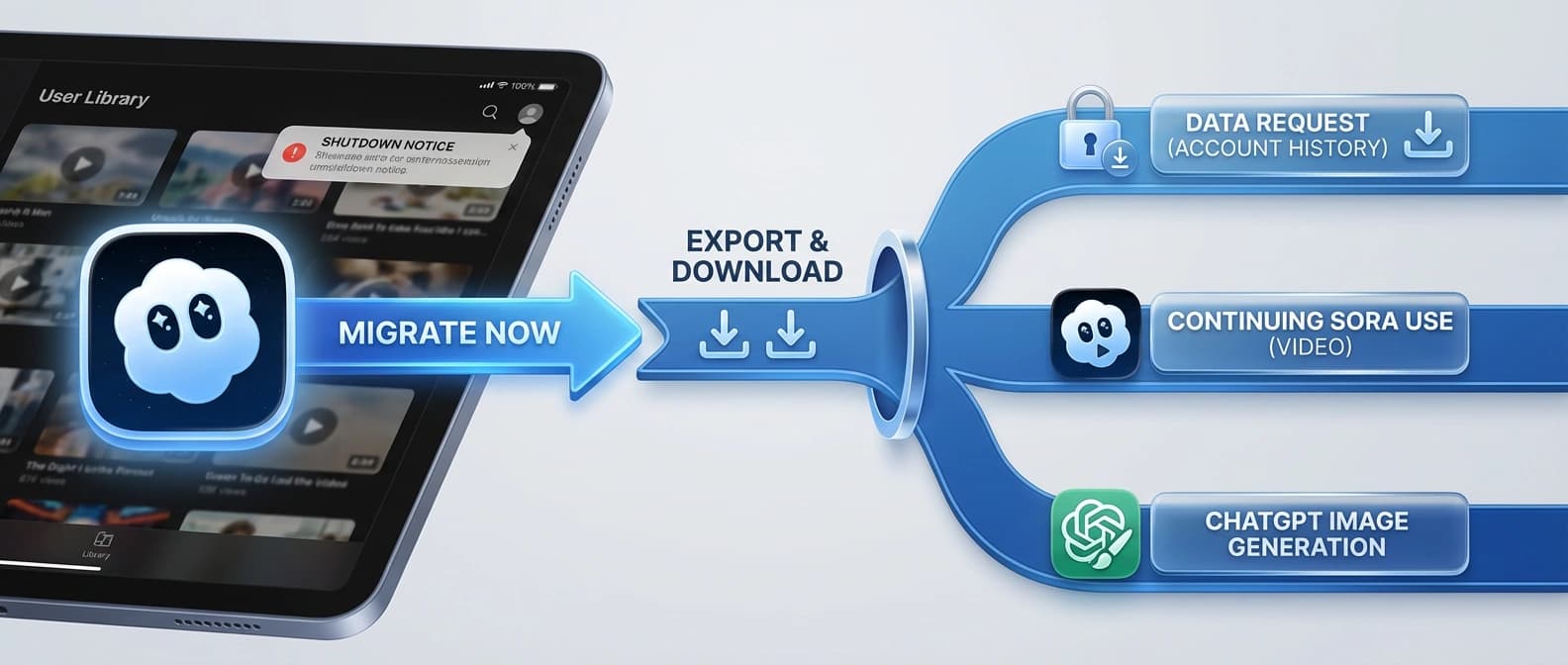
My practical read is straightforward:
- export Sora data from Settings > Data Controls if that surface is still available
- download individual videos and images from your library where possible
- if the old experience is already gone in your region, use OpenAI’s Privacy Portal to request data
- do not assume social traces like likes, remixes, or older public activity will stick around
There is another clue in the FAQ too. OpenAI says image generation will no longer be available in Sora once Sora 1 is removed and points users to ChatGPT for that instead. That makes this look even more like a rebundling exercise: trim the social app, keep some video capability elsewhere, and move image creation into a bigger surface OpenAI already cares about.
My read on what OpenAI is actually doing
My best read is that OpenAI is shutting down the standalone Sora app and its social shell while deciding how much of Sora 2 and the API survive under that name. That is a narrower and more boring story than “Sora is dead,” but boring is often where the truth lives.
If OpenAI means something broader, it needs to say so plainly. Right now the company’s own documents support multiple partial readings at once. One document says sunset. Another says Sora 2 remains the default. Another says here is your new editor. Another still documents the API.
So I would not write the obituary yet. I would write the transition memo. OpenAI is definitely closing a Sora surface. It is not yet clearly true that every Sora capability is gone. Our Disney fallout follow-up looks at what that retreat may cost strategically. Until the company publishes a clean migration page that explains the app, the API, and the surviving product boundaries in one place, the most honest description is also the messiest one: this looks less like a funeral and more like a badly signposted move-out.
Source file
Public source trail
These links anchor the package to the underlying reporting trail. They are not a substitute for judgment, but they do show where the reporting starts.
Primary shutdown announcement and the source of the app/API timeline language.
Confirms Sora 1 removal timing, export steps, and that Sora 2 remains the default experience in the U.S.
Shows the app still documented as a Sora 2 product surface with social and creation features.
Recent March 19 update shows OpenAI was still shipping new Sora product features days before the goodbye post.
Developer documentation still lists sora-2 and sora-2-pro video generation capabilities.
Useful mainstream framing of the shutdown announcement and outside concern around deepfakes.
Captures how the app was perceived as a social feed product and preserves the embedded shutdown quote.
Helpful for attributed claims about how abrupt the move looked from outside the company.

About the author
Talia Reed
Talia reports on product surfaces, developer tools, platform shifts, category shifts, and the distribution choices that determine whether AI features become durable workflows. She looks for the moment where a launch stops being a demo and becomes an ecosystem move.
- 34
- Apr 1, 2026
- New York
Archive signal
Reporting lens: Distribution is usually the story hiding inside the launch.. Signature: A feature matters when it changes someone else’s roadmap.
Article details
- Category
- AI Products
- Last updated
- April 11, 2026
- Public sources
- 8 linked source notes
Byline
Covers product surfaces, tools, and the adoption moves that turn AI features into durable habits.