OpenAI raises $122 billion to build a compute moat
OpenAI’s $122 billion round is a bid to lock in compute, push ChatGPT deeper into work, and make Codex the enterprise wedge of one big AI superapp.

 ainewssilo.com
This round looks less like fundraising than a reservation on future intelligence supply.
OpenAI's new $122 billion round is big enough to melt the usual funding adjectives, but the interesting part is not the adjective. It is the shopping list.
In the company's own announcement, OpenAI barely bothers to pretend this is a normal venture lap. It says durable access to compute is the strategic advantage. It maps out cloud partners, chip partners, and data-center partners like somebody trying to reserve half the industrial base before dinner.
That is the tell. This round is not just about making the cap table look like Davos with better hoodies. It is a bid to lock in the raw materials of frontier AI, then use ChatGPT's consumer reach to drag that advantage into work. The same post says OpenAI is building a "unified AI superapp" that combines ChatGPT, Codex, browsing, and broader agent capabilities. Read together, the message is blunt: own the compute, own the surface, own the habit loop.
I keep coming back to that combination because it explains why this story belongs in infrastructure, not only in finance. If OpenAI were merely celebrating growth, the post could have stayed in the safer territory of revenue, usage, and investor confidence. Instead it reads like a vertical-integration memo with slightly better branding.
The round reads like a compute reservation, not a victory lap
The cleanest line in OpenAI's post is also the least glamorous: durable access to compute is the strategic advantage that compounds across the entire system. That is not decorative language. That is the thesis.
OpenAI says its strategy now spans cloud partners including Microsoft, Oracle, AWS, CoreWeave, and Google Cloud; silicon through Nvidia, AMD, AWS Trainium, Cerebras, and a homegrown chip partnership with Broadcom; and data-center partnerships through Oracle, SBE, and SoftBank. In other words, it is not just buying more GPUs. It is building optionality across the whole supply chain.
That matters because frontier AI has an awkward habit of looking like software right up until you try to serve it at absurd scale. Then it starts looking like energy procurement, hardware contracts, and long-term capacity planning. The smartest model in the world does not help much if the compute pipeline pinches every time demand spikes. I read the $122 billion less as a chest-thump and more as a reservation fee.
Think of it like a bakery chain buying the ovens, flour contracts, and delivery vans before announcing a new menu. The bread still matters. But the business gets much harder to copy when you control the boring inputs.
That is also why the $852 billion valuation is doing more than rewarding momentum. Investors are underwriting OpenAI's claim that infrastructure scarcity can be converted into product leverage. If that claim holds, the company gets a moat that compounds. If it does not, this becomes one of the more expensive confidence tricks in recent memory.
ChatGPT is the consumer funnel, and Codex is the enterprise wedge
The funding post makes another unusually candid point: ChatGPT's broad consumer reach creates a distribution channel into the workplace. That sentence deserves more attention than the valuation sticker.
OpenAI says ChatGPT now has more than 900 million weekly active users and more than 50 million subscribers. Those are company numbers, so take them as company numbers. Even so, the strategic logic is obvious. If hundreds of millions of people already know where the box is, enterprise adoption gets easier. Familiarity travels.
We have been tracking pieces of that strategy for weeks. In OpenAI's agent stack is a distribution play, not a demo, the key move was workflow capture around models, tools, evals, and deployment. In OpenAI turns ChatGPT shopping into product discovery, the company looked less interested in owning checkout than in sitting upstream of intent. Same pattern. Own the front door, then keep expanding what happens after someone walks through it.
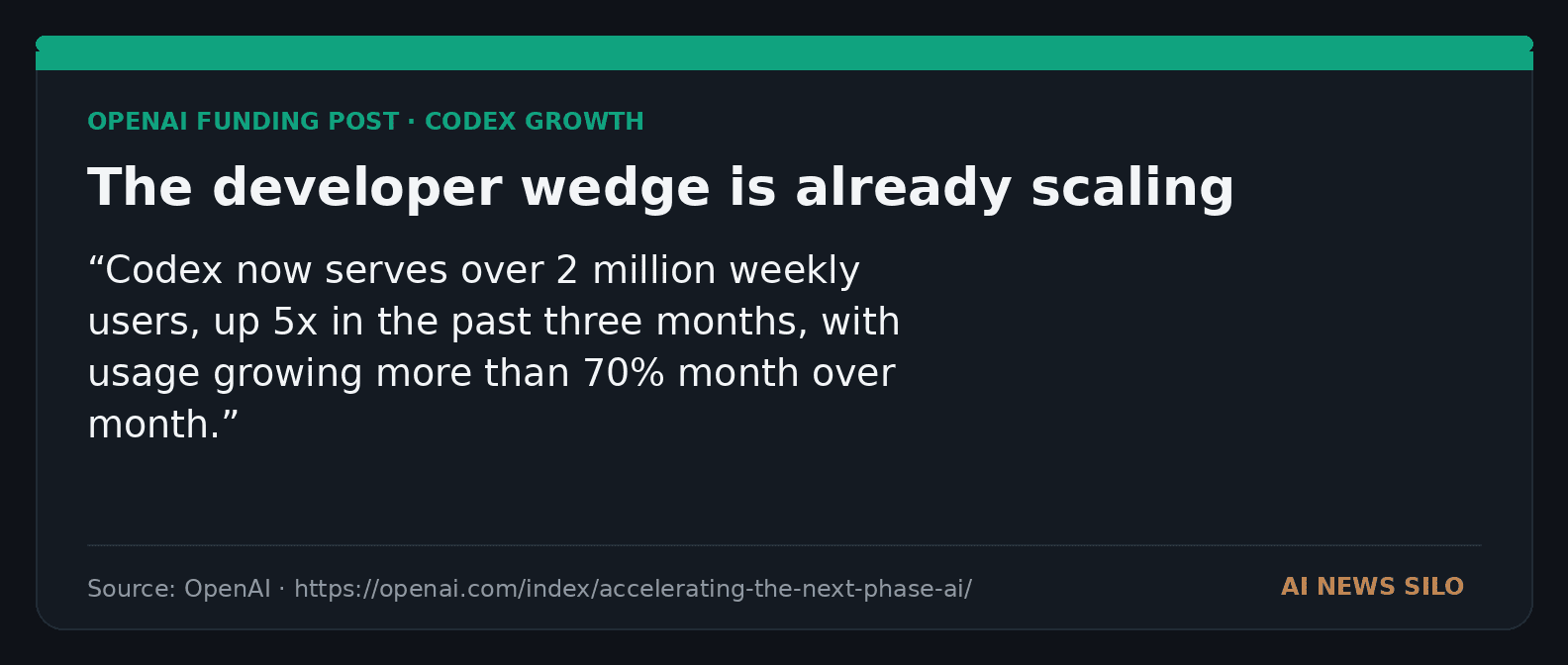
Codex matters here because it gives OpenAI a sharper way into work than a generic "AI assistant for everyone" pitch ever could. The company says Codex now serves more than 2 million weekly users, up fivefold in three months. If that is even directionally right, it helps explain why coding remains such a strategic beachhead.
Why the Codex number matters more than the funding theater
Developers create habit loops that spread. A coding tool used every day does not stay confined to one terminal for long. It seeps into review flows, deployment rituals, internal tooling, and team norms. That is why OpenAI's Codex plugin targets Claude Code and OpenAI Astral deal is a Python workflow power grab mattered. They were not just feature stories. They were distribution stories disguised as product updates.
Codex is the wedge because it moves OpenAI closer to work that already has a budget, a manager, and a painful backlog. Once a developer uses Codex to review code, rescue a task, or keep a workflow moving, OpenAI is no longer just the chatbot from lunch breaks. It becomes part of production.
That changes the economics of the whole company. Consumer attention gets you reach. Developer usage gets you workflow gravity. Enterprise deployment gets you recurring revenue. Put enough compute behind that stack and the flywheel starts to look less like a metaphor and more like a billing system.
The superapp talk is really a packaging strategy
Normally, "superapp" is one of those words executives use when "we would like to own more of your day" sounds too honest. But in this case the term tells you what OpenAI thinks the next phase requires.
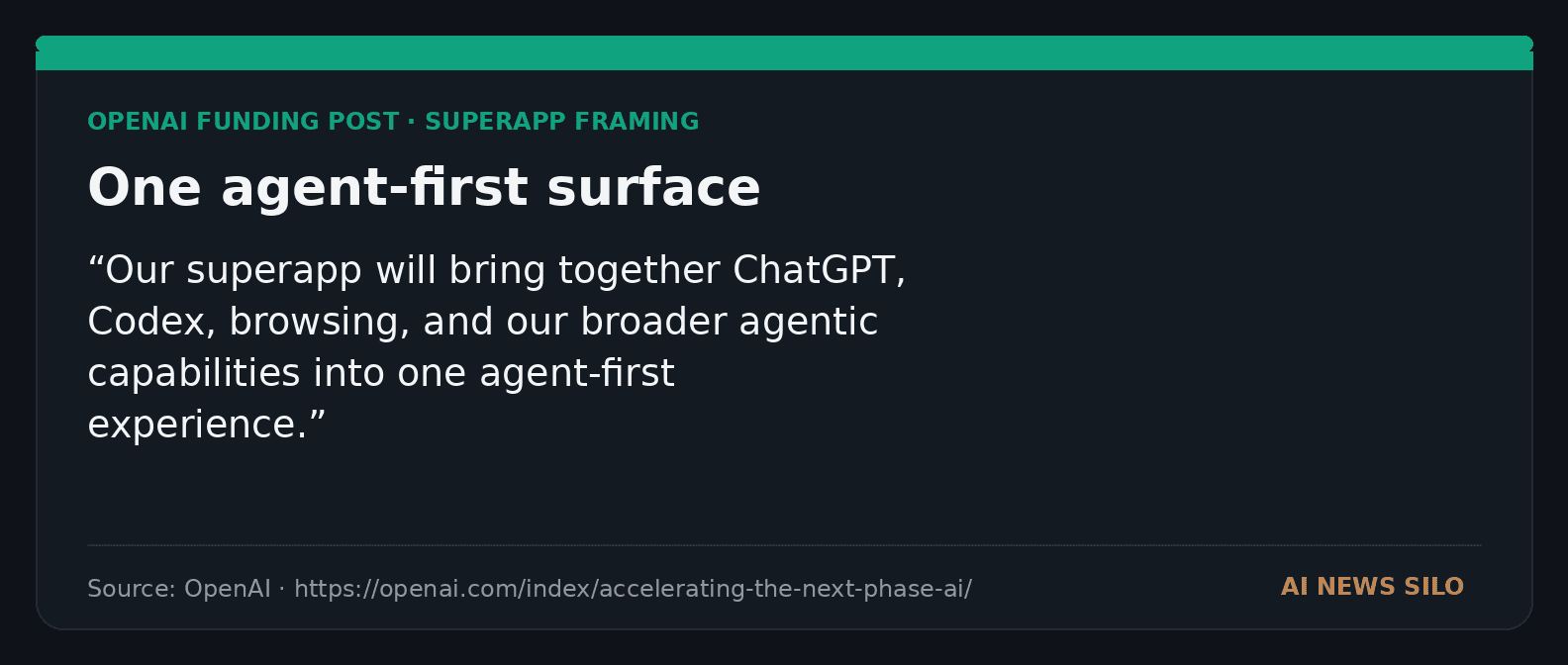
The company says it wants a unified AI superapp that brings together ChatGPT, Codex, browsing, and broader agent capabilities into one agent-first experience. The important part is not the slogan. It is the unification.
Separate surfaces leak value. A user chats in one place, codes in another, searches in a third, and hands real work off somewhere else. A unified surface makes that leakage harder. The same account, memory, identity, preferences, and action layer can travel across more tasks. That lets OpenAI translate model improvements directly into usage across multiple jobs instead of hoping users stitch the experience together themselves.
There is a second advantage here. One surface can train people into one habit. OpenAI does not need every product line to be the winner on its own if all of them feed the same top-level environment. ChatGPT brings scale, Codex brings higher-value work, browsing brings recency, and agents bring action. Bundle that together and you get something much stickier than a pile of impressive demos.
This is also where the round loops back to compute. A superapp only works if the system can carry a giant mix of consumer traffic, enterprise workflows, coding sessions, multimodal tasks, and agent actions without collapsing into latency, outages, or cost pain. Infrastructure is what makes the packaging believable.
Investors are buying the flywheel, not just the quarter
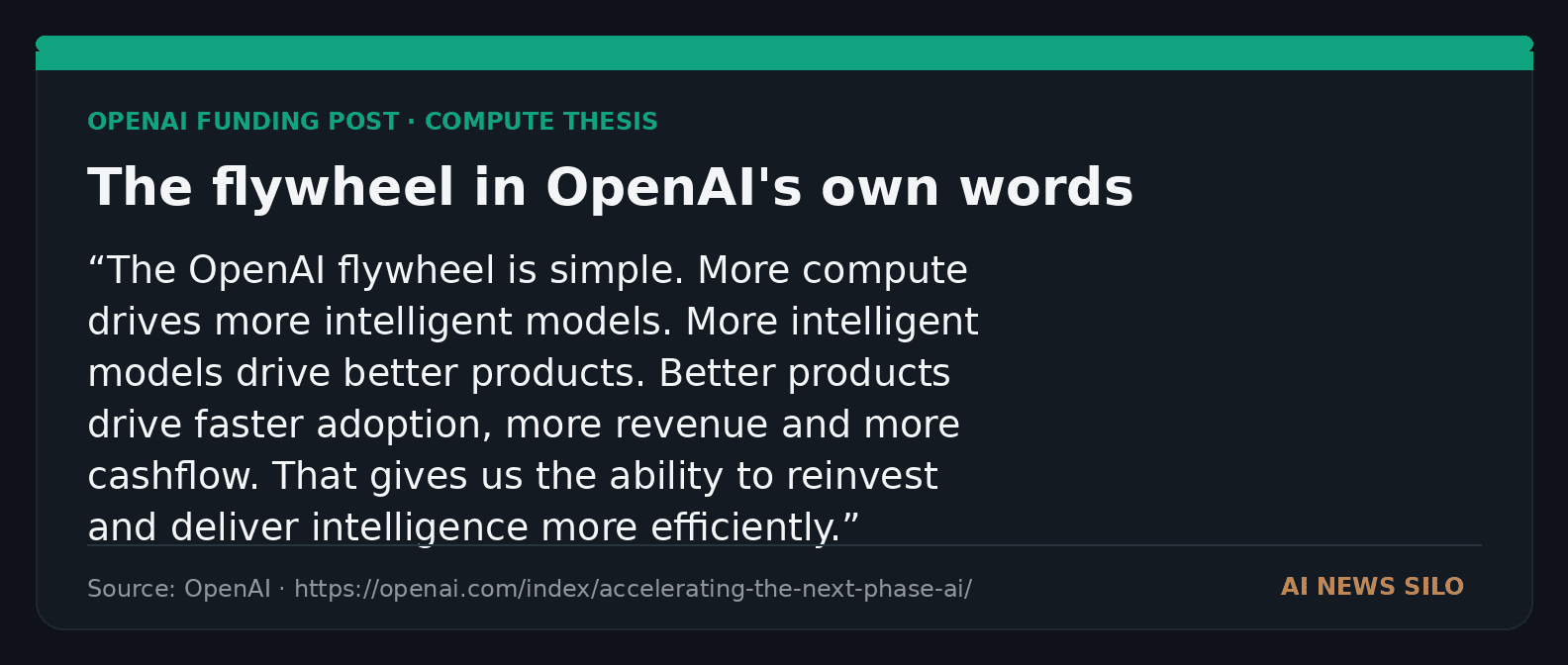
The most ambitious line in OpenAI's announcement is not about users or revenue. It is the flywheel itself: more compute drives more intelligent models, better models drive better products, better products drive adoption and cash flow, and the resulting capital funds more compute.
That is the pitch investors just paid to believe.
The Guardian's early coverage adds a useful bucket of cold water. OpenAI is still burning enormous sums, faces bubble skepticism, and is trying to convince the market that today's spending becomes tomorrow's operating leverage. Fair enough. A flywheel is still a theory until the margins arrive.
But I do think the company is aiming at the right pressure points. Frontier AI is increasingly a game of supply assurance, distribution control, and workflow capture all at once. You need the compute to serve the models, the product surface to reach users, and the sticky use cases that make people pay. Miss one leg and the stool gets weird fast.
My read is that OpenAI did not raise $122 billion because investors wanted to congratulate a successful chatbot. It raised $122 billion because the company convinced capital that intelligence is becoming a full-stack business. Not just model quality. Not just apps. Not just chips. All of it, feeding all of it.
That is why this round has teeth. It is a land grab for compute, a distribution bet on ChatGPT, and an enterprise wedge through Codex, wrapped in the polite fiction that "superapp" is merely a branding exercise. It is not. It is platform strategy with a smiley face on top.
Short version? OpenAI is trying to become very hard to route around.
Source file
Public source trail
These links anchor the package to the underlying reporting trail. They are not a substitute for judgment, but they do show where the reporting starts.
Primary source for the funding round, valuation, revenue, compute thesis, superapp framing, and the Codex / ChatGPT usage claims cited in the piece.
Independent early coverage used to frame the scale of the round and the skepticism around profitability and AI-bubble expectations.

About the author
Talia Reed
Talia reports on product surfaces, developer tools, platform shifts, category shifts, and the distribution choices that determine whether AI features become durable workflows. She looks for the moment where a launch stops being a demo and becomes an ecosystem move.
- 34
- Apr 1, 2026
- New York
Archive signal
Reporting lens: Distribution is usually the story hiding inside the launch.. Signature: A feature matters when it changes someone else’s roadmap.
Article details
- Category
- AI Infrastructure
- Last updated
- April 11, 2026
- Public sources
- 2 linked source notes
Byline
Covers product surfaces, tools, and the adoption moves that turn AI features into durable habits.