Google turns India into its public-sector AI template
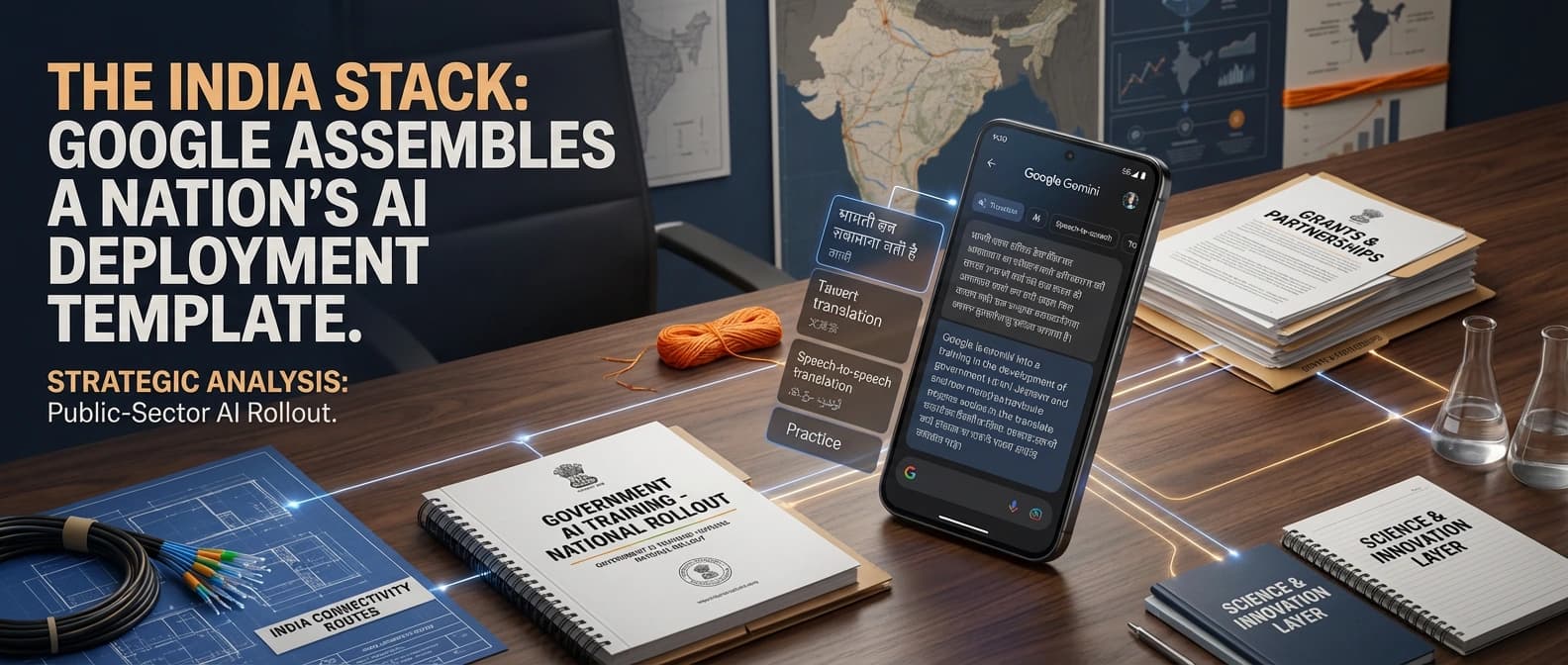
Google used AI Impact Summit 2026 in India to bundle fiber, cloud, grants, civil-service training, science partnerships, and localized Gemini features into one national rollout playbook.
 ainewssilo.com
Google did not announce one India feature. It announced a country-scale AI rollout stack.
Google’s AI Impact Summit 2026 package for India looks like a corporate sampler platter. This time, though, the bundle is disciplined.
Across the summit post and the supporting Google, Google Cloud, Google.org, and DeepMind announcements, the company ties together connectivity, cloud infrastructure, grant funding, public-servant training, science partnerships, and localized Gemini or Search features into one national story. India is not just where Google held the event. It is where Google is showing what a repeatable public-sector AI rollout can look like. If OpenAI’s $122 billion infrastructure push is about locking down supply, and Anthropic’s Australia MOU is about getting inside policy lanes, Google’s India move tries to do both while also keeping one foot in consumer habit. That is a much stickier pitch than one lonely government chatbot pilot.
Google AI Impact Summit India bundled the plumbing first
The clearest tell is America-India Connect. Google Cloud says the initiative is anchored by its five-year $15 billion AI infrastructure investment in India. It includes a new international subsea gateway in Visakhapatnam, three new subsea paths connecting India to Singapore, South Africa, and Australia, and four strategic fiber-optic routes linking the United States, India, and multiple points across the Southern Hemisphere.
This is the boring part of the story, which is exactly why it is the important part. Demo videos are fun. Fiber routes decide who can actually run things.
Google is making a policy argument through infrastructure. If the company can present itself as the actor helping increase reach, resilience, and reliability across India’s digital backbone, then every later AI conversation starts from a friendlier place. Public-sector AI programs need compute, connectivity, uptime, and data movement that do not fall over the minute the room gets serious. Google put that plumbing on stage instead of hiding it in appendix slides.
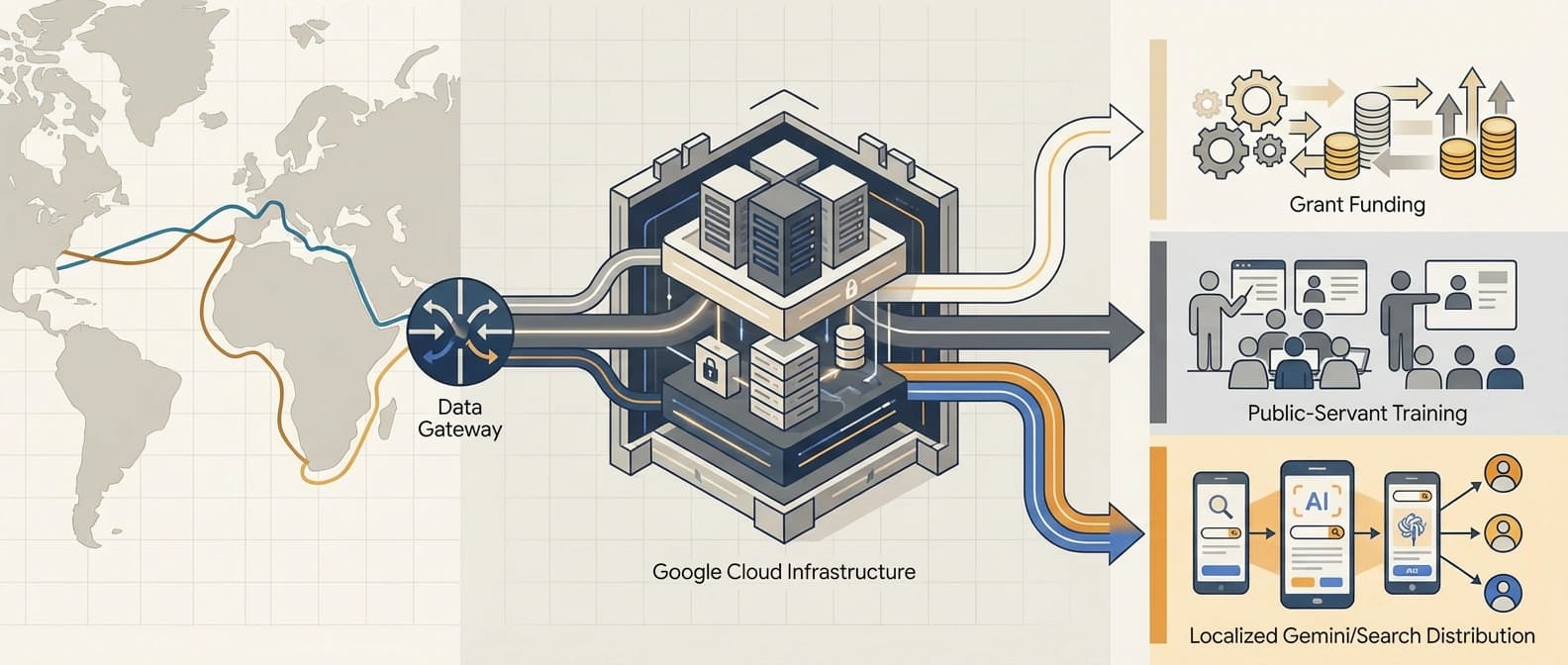
That is not random. We already saw Google obsess over distribution in our piece on Google AI Studio’s full-stack distribution play. The India package extends that instinct from developer tooling into national infrastructure and state-facing operations.
Karmayogi Bharat gives Google a daily civil-service surface
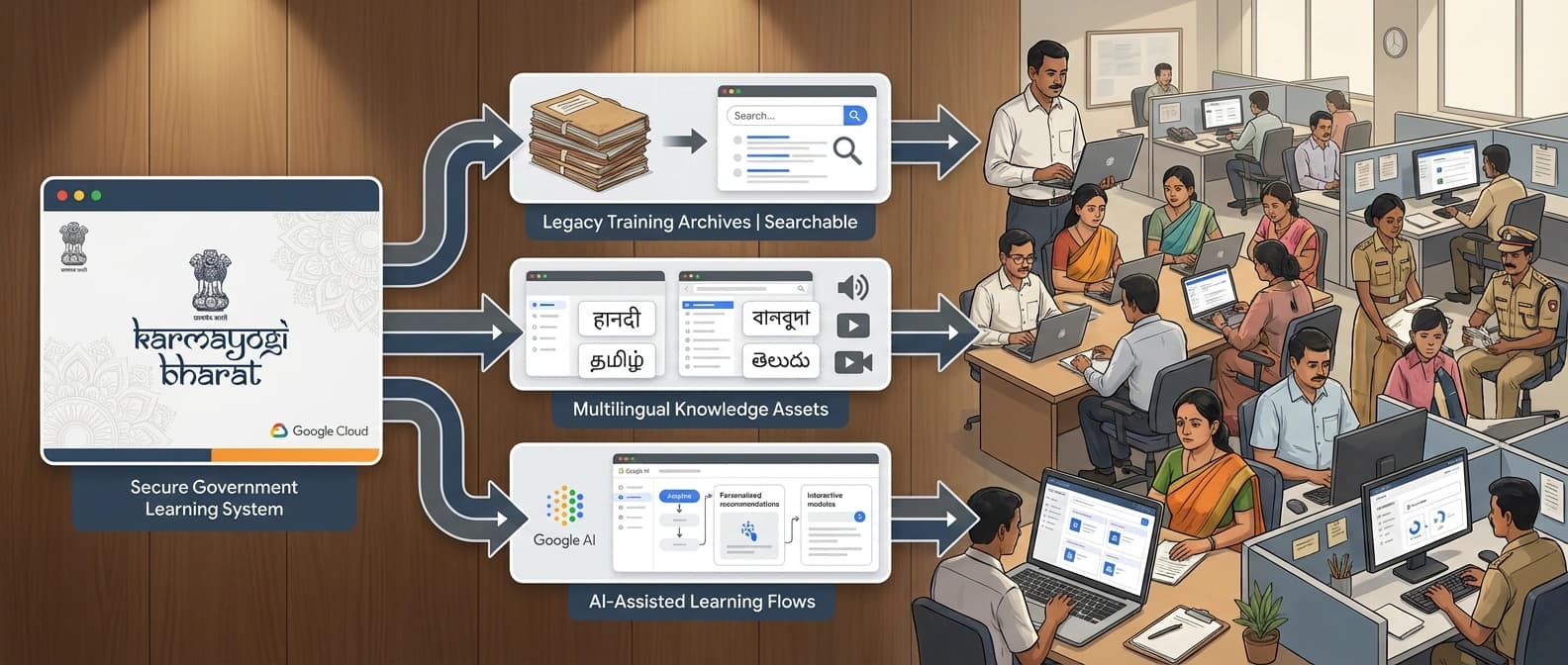
Infrastructure alone would still read like a nice cable map with better branding. The sharper move is that Google paired those routes with workflow through Karmayogi Bharat and Mission Karmayogi’s plan for a future-ready civil service. Google Cloud is the primary cloud partner for the iGOT Karmayogi platform, which it says supports more than 20 million public servants across 800+ districts. The company also says it will digitize legacy training repositories into searchable knowledge assets and progressively enable content in 18+ Indian languages.
That is much more consequential than a ceremonial skilling announcement. It puts Google inside the training loop for how public servants find material, learn new procedures, and build day-to-day familiarity with AI-enabled systems. A lot of “government AI” coverage stops at pilots. This looks more like the boring middle where habits get formed, which is where the real power usually hides.
Google backed that operational layer with a money layer. The new Google.org Impact Challenge: AI for Government Innovation sets aside $30 million for nonprofits, social enterprises, and academic institutions building AI-powered public-service tools, plus accelerator support, engineering help, and Google infrastructure. Conveniently enough, Google cites survey data showing public servants already use AI widely while only 18% think governments are using it effectively. Google is positioning itself as the bridge between those two realities, which is a very comfortable place to stand if you also sell the cloud.
DeepMind adds the science and education layer to the India package
The DeepMind piece is where the summit stops looking like a collection of adjacent announcements and starts looking like one state-capacity stack in a trench coat.
Through its National Partnerships for AI initiative, Google DeepMind says it is working with Indian government bodies and local institutions on science and education. That includes work with the Anusandhan National Research Foundation, access to frontier AI for Science models such as AlphaGenome and AI Co-scientist, hackathons and mentorship, and education partnerships that run through schools, teachers, and students.
That changes the pitch. Google is not just selling cloud capacity and a grant program. It is adding frontier science access and a classroom path that make the whole thing feel national rather than departmental.
It also gives Google more than one constituency to please. Ministries, research institutions, schools, nonprofits, and cloud buyers all get their own lane in the same package. Corporate bundling often feels like somebody stuffed five brochures into one tote bag and called it synergy. This is closer to a rollout script.
Gemini translation in India gives the state pitch a consumer rail
The consumer product layer may look like a detour, but I think it is one of the smartest parts of the package.
The summit post says Google’s live speech-to-speech translation model supports real-time translated conversations in over 70 languages, including 10 Indic languages. The underlying translation post says the beta is rolling out in the Translate app on Android in India, and that Gemini-powered text translation is launching in India between English and nearly 20 languages, including Hindi. Google also says Search Live will soon support more own-language queries, including Hindi, and that India is already among its top three countries for both Gemini and AI Mode.
Why does that matter for a public-sector story? Because national AI rollout gets easier when the same model family already lives in citizens’ phones, classrooms, and headphones. The company is reducing the weirdness gap. A government worker trained on AI-enabled systems is less likely to experience Google’s public-sector offer as some sealed procurement object if the same brand is already helping with translation, search, and study habits outside the office.
This is where the package lines up with our earlier read on Gemini 3.1 Flash’s live agent rail. Google likes shared rails. It likes one model family feeding many surfaces. India gives it a place to show that logic at national scale.
Why India now looks like Google’s public-sector AI template
I’ve read enough summit copy to know when a company is simply throwing glitter over unrelated product notes. This package feels more methodical.
The playbook is visible. First, build or finance the connectivity and cloud layer. Second, enter the public-service workflow through training and searchable knowledge systems. Third, fund outside institutions that can turn Google’s stack into public-interest pilot projects. Fourth, place frontier models inside science and education partnerships. Fifth, localize consumer products so the same technical base becomes familiar across daily life.
That is the template.
None of this proves Google has solved government AI adoption in India. It also does not prove that other countries will buy the same package whole. The source set here is still Google talking about Google, and a sensible editor should keep one eyebrow up. But the strategic shape is hard to miss. India is the proving ground because it is large, multilingual, digitally ambitious, and politically meaningful enough to function as a public demo for the rest of the world.
So the real news from AI Impact Summit 2026 is not that Google announced one more feature, one more grant, or one more partnership. It is that Google used India to show how all of those pieces can lock together. That is much harder to copy than a launch slide. It is also why this story is bigger than the summit stage.
Source file
Public source trail
These links anchor the package to the underlying reporting trail. They are not a substitute for judgment, but they do show where the reporting starts.
Umbrella summit post that ties together connectivity, government capacity, science partnerships, skilling, and localized product rollouts.
Primary source for the $30 million government-innovation challenge, application scope, and accelerator support.
Primary source for the fiber and subsea buildout, the Vizag gateway, Karmayogi Bharat details, and the $15 billion infrastructure anchor.
Primary source for DeepMind’s national-partnership framing, ANRF work, and science-and-education access layer.
Primary source for the India rollout of Gemini-powered translation, live speech-to-speech beta, and the broader consumer distribution layer.

About the author
Maya Halberg
Maya writes across the AI field, from research claims and benchmark narratives to tools, products, institutional decisions, and market shifts. Her reporting stays focused on what changes once hype meets deployment, procurement, workflow reality, and human skepticism.
- 24
- Apr 11, 2026
- Stockholm · Remote
Archive signal
Reporting lens: Methodology over launch theater.. Signature: A result only matters after the setup becomes legible.
Article details
- Category
- AI Policy
- Last updated
- April 11, 2026
- Public sources
- 5 linked source notes
Byline
Writes across the AI field with an eye for what survives contact with real users, real budgets, and real operating constraints.