DeepSeek outage shows AI's uptime race is here
DeepSeek was down for 7 hours and 13 minutes on March 30. The larger story is that AI labs now have to win boring things like uptime too.
 ainewssilo.com
Benchmarks can win a launch cycle. They do not answer when the status page turns red.
If you woke up searching Is DeepSeek down today?, the answer on March 30 was yes, and not in the cute little "give it a minute" way. DeepSeek's official status page logged a major outage starting at 00:20 CST and did not mark the incident resolved until 10:33 CST. Reuters, citing that same status data, calculated the disruption at 7 hours and 13 minutes.
That alone makes it news. I think the more interesting part is what kind of news it is.
DeepSeek became one of the most important names in AI by doing the exciting stuff: shipping models that rattled incumbents, resetting expectations around cost, and turning every frontier lab into a slightly more nervous version of itself. But once a chatbot becomes part of everyday work, users start grading it on a much less glamorous metric. Does it load. Does it answer. Does it stay up when somebody needs it more than once.
Silicon Valley loves heroic nouns. Users are usually here for a functioning verb.
Was DeepSeek down today? Yes, for more than seven hours
DeepSeek's public status log shows a night that never quite decided whether it was fixed.
- 00:20 CST — Investigating
- 00:36 CST — Update: still investigating
- 01:24 CST — Monitoring after a fix was implemented
- 02:16 CST — Back to investigating
- 09:13 CST — Monitoring again after another fix
- 10:33 CST — Monitoring update and final resolution
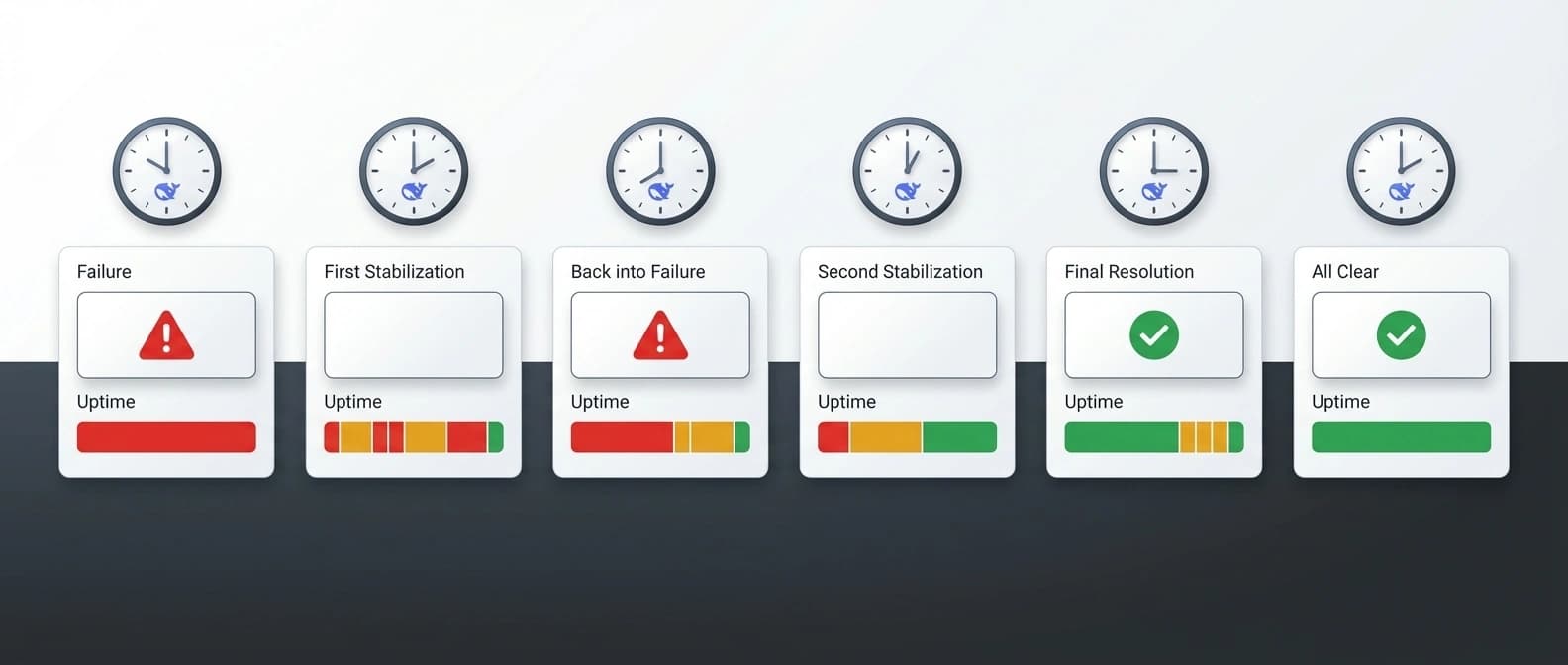
That sequence matters because it tells you this was not a single clean restart followed by coffee. It was the status-page version of "we thought we had it, then we absolutely did not."
DeepSeek has not disclosed a cause. That is the factual edge editors need to keep clean. The company says the incident is resolved. It has not said what broke, why the first apparent recovery did not hold, or whether a fuller postmortem is coming.
Reuters called this DeepSeek's longest outage since the viral rise of its R1 and V3 models in early 2025. The same report also noted that, according to DeepSeek's status data, the regular chatbot webpage had not seen a major outage longer than two hours before Monday, even though the API had experienced day-long incidents in late January 2025.
DeepSeek outage timeline on March 30 felt different for a reason
A lot of tech outages are forgettable. A product goes soft for twenty minutes, social media complains, the service comes back, and everyone returns to pretending uptime is a law of nature.
This one lasted long enough to change category.
Business Standard, citing Bloomberg, described the downtime as unusual for a globally used app and said DeepSeek had maintained roughly a 99 per cent operational record since unveiling R1 in January 2025. That sounds reassuring right up until you remember what percentages feel like from the user side. Ninety-nine per cent uptime looks excellent on a slide. The missing 1 per cent has an unfortunate habit of arriving in the middle of someone's deadline.
This is why outage stories are no longer side quests in AI coverage. Frontier chatbots are increasingly treated like work infrastructure: drafting assistant, coding helper, research shortcut, translation buddy, summarizer of last resort. People may still talk about them like magical companions from the future, but they use them like office software with a better vocabulary.
Once a tool moves into that slot, reliability stops being back-office trivia. It becomes part of the product.
Why DeepSeek's longest outage matters for AI reliability
The DeepSeek story up to now has been easy to tell. A Chinese lab ships aggressive models, moves fast, pressures pricing, and makes the rest of the market explain why its moat is still a moat. That story is built on capability and cost.
The harder chapter is operations.
I keep coming back to how much of the industry's real competition has drifted into the supposedly boring layer. We write about open-weight inference economics and orchestration systems like NVIDIA Dynamo because the flashy model demo eventually hits the wall of serving reality. The user does not see most of that stack. They feel it when it fails.
The same is true for efficiency work like KV cache compression. A cheaper or smarter stack still has to stay upright when people actually depend on it.
That is also why this story sits next to our broader AI infrastructure coverage even though the category fit is product news.
The market spent the past year obsessing over who had the smartest model, the cheapest tokens, or the best benchmark card. Those things matter. But a benchmark win does not keep the service alive at 02:16 CST when the status page flips from monitoring back to investigating. Our own piece on why benchmark wins feel less trustworthy makes a related point from the research side: the score is only the top layer. Reliability is part of the rest of the stack.
There is some mild irony here, and I mean mild. DeepSeek became famous by making frontier AI feel cheaper and more strategically disruptive. Now it has been handed the same old enterprise test every serious platform eventually gets: can you make the impressive thing reliably boring?
Boring wins markets.
What still needs answers after DeepSeek came back online
For now, the clean public facts are limited. DeepSeek says the incident is resolved. Reuters says the outage lasted 7 hours and 13 minutes and was the longest since DeepSeek's breakout. Business Standard, sourcing Bloomberg, says the disruption was unusual given the company's status history. The cause is still undisclosed.
That leaves four practical follow-ups worth watching before publish or in any update:
- whether DeepSeek publishes a postmortem with a root-cause explanation
- whether developers report meaningful spillover beyond the consumer chatbot surface
- whether similar reliability issues recur in the next few days
- whether this changes the tone around DeepSeek's next model release, which the market is already waiting for
That last point matters more than it may seem. When everyone expects your next big model, every outage becomes part of the launch narrative whether you like it or not. Reliability is boring only until it is the only thing anybody wants to ask about.
DeepSeek is back up. Good. But March 30 was a reminder that the frontier race is not just about whose model looks smartest in a screenshot. It is also about who can become dependable enough to disappear into someone's routine. Capability gets attention. Reliability gets habit. And habit is the part that lasts.
Source file
Public source trail
These links anchor the package to the underlying reporting trail. They are not a substitute for judgment, but they do show where the reporting starts.
Official incident log with the March 30 investigation, monitoring, and resolved timestamps.
Provides the 7 hour 13 minute duration, longest-outage framing, and context on prior service incidents.
Adds outside framing on how unusual the downtime was and cites DeepSeek's roughly 99 per cent operational record since January 2025.

About the author
Talia Reed
Talia reports on product surfaces, developer tools, platform shifts, category shifts, and the distribution choices that determine whether AI features become durable workflows. She looks for the moment where a launch stops being a demo and becomes an ecosystem move.
- 34
- Apr 1, 2026
- New York
Archive signal
Reporting lens: Distribution is usually the story hiding inside the launch.. Signature: A feature matters when it changes someone else’s roadmap.
Article details
- Category
- AI Products
- Last updated
- April 11, 2026
- Public sources
- 3 linked source notes
Byline
Covers product surfaces, tools, and the adoption moves that turn AI features into durable habits.