Signed reporting across six AI categories, built to keep the archive useful after the launch noise burns off.

Edition brief6 AI categories/Stable category archives/Machine-readable discovery
AI PolicySigned reporting
Published March 24, 2026

Microsoft's Foundry Local turns sovereign AI into a packaged stack

Foundry Local, Azure Local, and NVIDIA hardware turn sovereign AI from a fuzzy compliance promise into a stack governments and regulated buyers can actually procure.


Idris ValeStaff Writer7 min read
The interesting move is not that Microsoft can say “sovereign AI” louder. It is that it now has a stack to sell under that label.
Editorial illustration of a sealed sovereign AI control room where policy gates, local GPUs, and Microsoft-managed software layers sit inside one customer-controlled boundary.
AI PolicyCover / AI Policy

Lead illustration

Microsoft's Foundry Local turns sovereign AI into a packaged stack
Cover / AI PolicyMicrosoft's latest move is less about saying "sovereignty" louder and more about shipping a full stack buyers can actually evaluate.

Sovereign AI has spent the last year hovering in that annoying zone between real requirement and empty slogan. Everybody can say the phrase. Far fewer vendors can explain what a government, defense buyer, or regulated operator is actually supposed to buy.

Microsoft is starting to close that gap.

The interesting move is not that the company can say “sovereignty” louder than rivals. It is that Microsoft now has the bones of a sellable local stack: Azure Local disconnected operations, Foundry Local for large models inside customer-controlled environments, Azure Arc and AKS as the management layer, and a very explicit NVIDIA hardware path underneath it.

That matters because regulated buyers do not purchase abstractions. They buy documented operating models, approved hardware, support contracts, and governance they can explain to auditors later. In other words, they buy something much closer to a stack than a slogan.

Microsoft is packaging the full boundary, not just the model runtime

Microsoft's February sovereign-cloud announcement was more revealing than the usual “AI plus compliance” marketing copy. The company did not talk only about local inferencing. It bundled three layers together: Azure Local for disconnected infrastructure, Microsoft 365 Local for productivity inside the same boundary, and Foundry Local for bringing larger models into that environment.

That package is important because it answers the first boring-but-decisive buyer question: what sits inside the operational boundary with the model? For a lot of sovereign buyers, the answer cannot be “just enough to demo the AI piece.” It has to include governance, identity, operations, and the parts of the software estate people will actually rely on when the environment is intermittently connected or fully isolated.

Microsoft says Foundry Local now lets qualified customers run large multimodal models on their own hardware inside fully disconnected sovereign environments, using modern infrastructure from partners such as NVIDIA. That is not universal proof of field deployment, and it should not be read that way. But it is a real shift in the pitch. The company is no longer selling sovereignty as a thin wrapper around public cloud policy controls. It is selling a sovereign private-cloud operating model with AI attached.

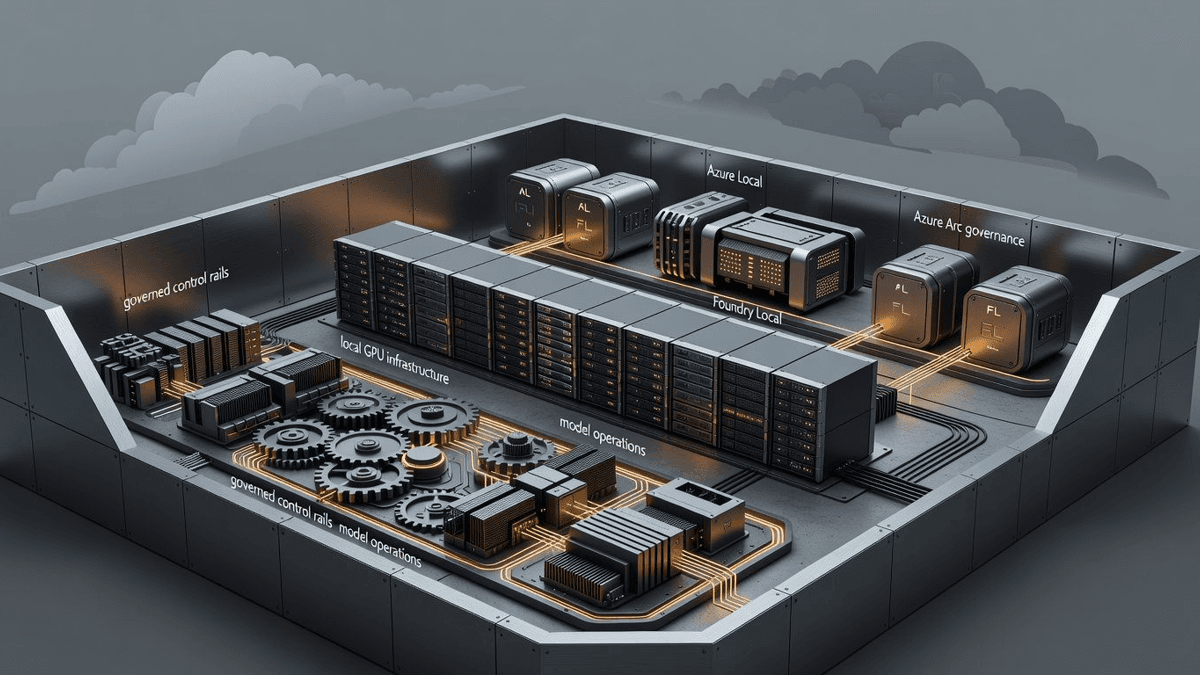
Editorial figure showing Azure Local, Foundry Local, and local GPU infrastructure operating inside one governed sovereign boundary.
Figure / 01 The commercial shift is the packaging: governance, model operations, and accelerated hardware are being sold as one local stack.

That is also why this belongs in the policy lane, not only the infrastructure lane. Institutional adoption often stalls long before the model question. It stalls at the boundary question: where does the system run, who manages updates, how does governance stay consistent, and what breaks when connectivity disappears? The more Microsoft can answer those questions with one recognizable stack, the easier the procurement conversation gets.

If that sounds familiar, it should. In our earlier piece on EU AI procurement, the real argument was that regulation matters, but procurement is where policy hardens into market structure. This Microsoft move fits that logic almost perfectly. Buyers under sovereignty pressure do not just want a compliant model. They want a package they can approve repeatedly.

NVIDIA gives the sovereignty pitch a hardware roadmap

The GTC follow-through is where the story became more concrete.

In Microsoft's March post tied to NVIDIA GTC, the company said its sovereign and regulated-environment push now includes initial support for the NVIDIA Rubin platform on Azure Local. The more detailed Azure Arc team post goes further: Azure Local 2603 generally supports NVIDIA RTX PRO 6000 Blackwell Server Edition today, more Blackwell-series support is coming, Rubin is on the roadmap, and OEM partners including Dell, HPE, and Lenovo are part of the validated hardware path.

That is not a small detail. It changes sovereign AI from a philosophical preference into a purchasing menu.

A government agency or regulated enterprise does not want to hear only that sovereignty is possible in principle. It wants to know whether there is hardware available now, whether that hardware has a next-generation path, whether the software layer stays consistent across both, and whether known OEMs can sell and support the box. Microsoft's answer is now visibly closer to yes.

There is a second-order effect too. Once Microsoft ties Foundry Local to Azure Local and then ties Azure Local to named NVIDIA platforms, it gives the buyer a continuity story. Start on Blackwell-based systems now. Keep the governance model. Keep the management plane. Move up the acceleration curve later. For cautious buyers, that is much easier to defend internally than a bespoke sovereign build assembled from unrelated components.

It also overlaps with the economics question. If a buyer wants advanced models close to sensitive data, then our earlier piece on open-weight inference economics becomes part of the same conversation. Sovereignty is not just about legal posture. It is about whether local execution, data control, and hardware utilization create a deployment shape worth paying for.

The real commercial move is procurement compression

This is the part I think a lot of launch coverage misses. Microsoft is not just extending Azure into air-gapped rooms. It is compressing a messy buying process.

Normally, a sovereign AI project asks the buyer to assemble too many pieces alone: hardware selection, local orchestration, model runtime, policy enforcement, update strategy, support responsibility, and the awkward question of how closely the sovereign environment still resembles the cloud estate the team already knows. Each extra decision slows the sale and scares legal, security, and operations teams in its own special way.

By tying Foundry Local, Azure Local, Azure Arc, AKS, and NVIDIA-backed hardware into one story, Microsoft is trying to reduce that assembly burden. The pitch becomes simpler: here is the local operating model, here is the governance layer, here is the hardware path, here is how the AI stack evolves over time.

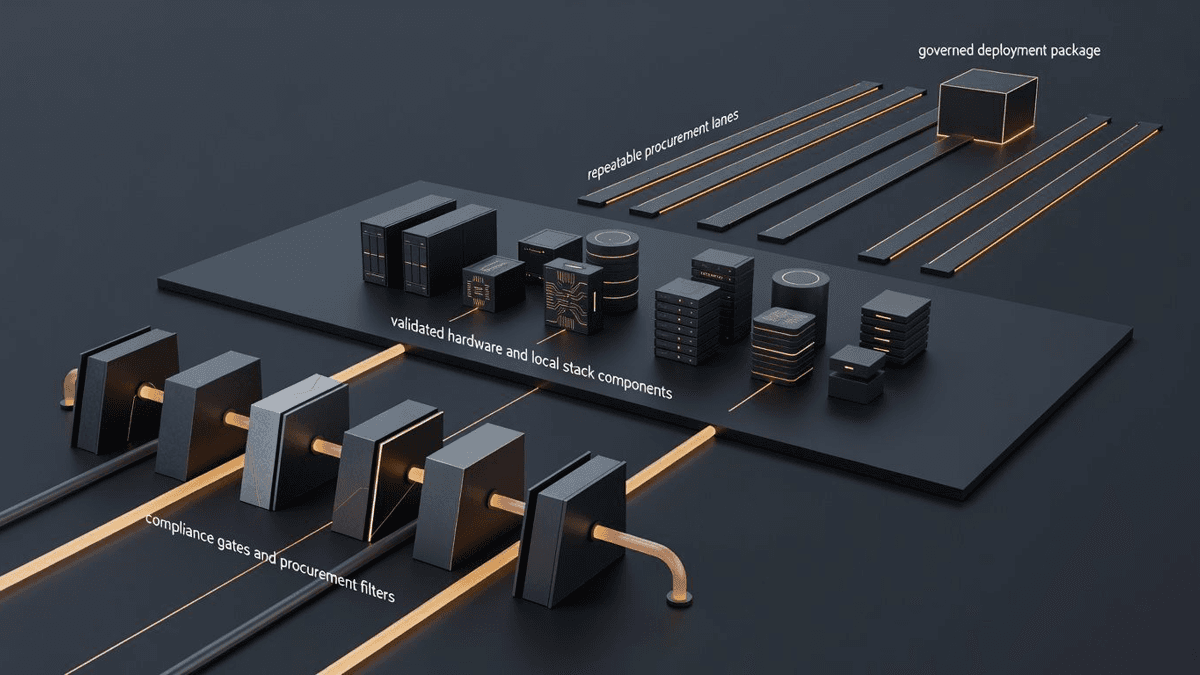
Diagram-style editorial figure showing how sovereignty requirements flow into approved hardware, local operations, and repeatable procurement lanes.
Figure / 02 Sovereign AI becomes easier to buy once the hardware roadmap, control plane, and operating model arrive as one documented package.

That is why the phrase “packaged stack” matters more than “sovereign AI.” The former sounds like something a procurement team can compare, document, and rebuy. The latter still sounds like a workshop topic.

There is an echo here of the broader infrastructure narrative we have been tracking in NVIDIA's telecom AI-grid push. In both cases, the market is getting more serious about locality as a sellable feature. But locality only becomes commercially useful when it arrives with a buying motion. Microsoft now has a much cleaner one than many rivals do.

Sovereignty still is not the same thing as independence

That said, buyers should keep a cold eye on the gap between control and dependence.

A sovereign stack built around Microsoft software layers, Microsoft APIs, Azure-consistent governance, and NVIDIA hardware is still a stack with very obvious anchor tenants. For many public-sector and regulated customers, that will be a perfectly rational trade. They do not necessarily want purity. They want something they can run locally without losing vendor support or operational coherence.

Still, it would be silly to confuse this with maximal independence. If the control plane, model packaging, lifecycle story, and hardware roadmap all point back to the same few vendors, sovereignty becomes managed dependence under tighter local control, not full strategic autonomy. That may be good enough. It is not the same thing.

The ITPro coverage of Microsoft's launch gets close to the real buyer mood here. These customers are dealing with constant churn in regulation, cybersecurity expectations, and geopolitical risk. They are not shopping for ideological perfection. They are shopping for something flexible enough to survive policy change without ripping out the whole environment.

What to watch after the announcement wave

The next proof points will not come from prettier sovereignty language. They will come from deployment evidence.

Do governments and regulated industries actually buy this as one package, or do they still treat it as a menu of separate projects? Does the Foundry Local model catalog become broad enough to matter in sensitive environments? Can Microsoft keep the local API and governance experience close enough to Azure that teams do not feel like they are learning a second platform? And how much of the value lives in Microsoft software versus the NVIDIA roadmap and OEM channel underneath it?

Those are the questions that will decide whether this story belongs only in a launch archive or becomes a real marker for the AI Policy category. For now, though, one thing is clear: Microsoft has moved sovereign AI a step away from compliance theater and a step closer to something institutions can actually buy.

That is a meaningful shift. Not because the slogan got better, but because the stack did.

Source file

Public source trail

These links anchor the package to the underlying reporting trail. They are not a substitute for judgment, but they do show where the reporting starts.

Primary sourceblogs.microsoft.comMicrosoft
Microsoft Sovereign Cloud adds governance, productivity and support for large AI models securely running even when completely disconnected

Core announcement that ties Azure Local disconnected operations, Microsoft 365 Local, and Foundry Local into a sovereign private-cloud stack.

Primary sourcetechcommunity.microsoft.comMicrosoft Tech Community
Building Microsoft’s Sovereign AI on Azure Local with NVIDIA RTX PRO and Next Gen NVIDIA Rubin

Most concrete source for the NVIDIA hardware roadmap, Blackwell availability, Rubin support, AKS on Azure Local, and OEM validation story.

Primary sourceblogs.microsoft.comMicrosoft
Microsoft at NVIDIA GTC: New solutions for Microsoft Foundry, Azure AI infrastructure and Physical AI

Connects the sovereign stack to Microsoft’s broader GTC pitch around inference-heavy, reasoning-based, and regulated AI workloads.

Supporting reportingitpro.comITPro
Microsoft CEO Satya Nadella talks up sovereign cloud credentials as firm announces general availability for Azure Local disconnected, new capabilities for Foundry Local

Useful outside framing for how Microsoft is positioning the package to air-gapped and tightly regulated buyers, and for the emphasis on AMD and NVIDIA hardware rather than Maia.

Portrait illustration of Idris Vale

About the author

Idris Vale

Staff Writer

View author page

Idris writes about the institutional machinery around AI, but the lens is broader than policy alone: procurement frameworks, public-sector buying rules, platform leverage, compliance burdens, workflow risk, and the market structure hiding beneath product or infrastructure headlines. The through-line is practical power, not abstract theater.

Published stories
2
Latest story
Mar 24, 2026
Base
Brussels · London corridor

Reporting lens: Follow the buying process, not just the bill text.. Signature: Policy turns real when someone has to buy the system.

Related reads

More reporting on the same fault line.

AI Policy/Mar 14, 2026/6 min read

EU AI procurement may matter more than the next lab headline

EU AI procurement may matter more than the next lab headline because vendors that are easiest to approve, document, and rebuy could capture the market.

Editorial illustration of a European procurement map with compliance gates, institutional blocks, and AI vendor pathways converging into approved lanes.
AI PolicyFiled / MAR 14, 2026

Lead illustration

EU AI procurement may matter more than the next lab headlineRead EU AI procurement may matter more than the next lab headline
Filed / MAR 14, 2026Regulation sets the floor. Procurement determines which suppliers become easy to buy repeatedly.
AI Infrastructure/Mar 20, 2026/6 min read

NVIDIA AI grids turn telcos into inference resellers

NVIDIA's AI grid pitch turns telecom networks into distributed inference sellers, but operators still need products developers and buyers will actually use.

Editorial illustration of a telecom tower radiating distributed inference lanes across nearby edge sites, roads, devices, and city infrastructure.
AI InfrastructureFiled / MAR 20, 2026

Lead illustration

NVIDIA AI grids turn telcos into inference resellersRead NVIDIA AI grids turn telcos into inference resellers
Filed / MAR 20, 2026The AI-grid pitch is really a plan to turn the telecom footprint into sellable inference capacity.
Microsoft's Foundry Local turns sovereign AI into a packaged stack | AI News Silo